WITH EMPLOYEES
5,576
U.S. CENSUS CBP 2023
 U.S. FORMATION DATA & GUIDES
 To start a construction company in Georgia you'll file Articles of Organization through eCorp ($100) and get a free EIN from the IRS. The building work is licensed by the State Licensing Board for Residential and Commercial General Contractors, in four categories, and the line is low: a single family residence contract counts once the value of the work or your compensation, whichever is greater, passes $2,500. The license belongs to an individual who then acts as the qualifying agent for the company, and the liability insurance is carried in that person's name, at $300,000 for residential-basic and $500,000 for the rest. Total state LLC filing: ~$100 and a $50 annual registration.
272,381 new business applications in Georgia (last 12 mo) ▲ 15% YoY
Georgia draws its line lower than any other board state in this pilot and measures it from whichever side is larger. The State Licensing Board for Residential and Commercial General Contractors sets the trigger in its own warranty rule: a covered contract is a contract to construct, or to superintend or manage the construction of, a single family residence where the total value of the work, or the compensation the contractor receives for it, exceeds $2,500. North Carolina starts at $40,000 and California at $1,000 of labor and materials. Georgia takes the greater of two figures and starts at $2,500, which puts most of a working week inside the licensed zone.
The board licenses in four categories and the money asked of each is not the same. Residential Basic and Residential Light Commercial both want a minimum net worth of $25,000, with general liability of $300,000 and $500,000 per occurrence. Commercial General Contractor wants $150,000 of net worth against the same $500,000 of liability. Commercial General Contractor Limited Tier wants $25,000, and is the only one of the four with a ceiling on the job: $1 million per project. Workers’ compensation is separate and follows the state’s own rule, which starts at three or more employees, so a small owner crew sits under it.
Experience is what separates the categories in practice. A residential-basic applicant has to be at least 21, show two years of proven experience worked predominantly in that category, show significant responsibility for the successful completion of at least two projects in that category in the two years immediately before applying, and pass the exam. A commercial general contractor applicant meets one of three routes instead: a relevant four-year degree plus a year of experience, an acceptable mix of college credits and practical experience totalling four years, or four years of proven construction experience with at least two as or employed by a general contractor and at least one in administration, estimating, drafting, engineering, supervision or project management. Nobody is grandfathered past the exam, and an approved applicant gets three sittings inside a year before a one-year wait applies.
The entity question gets its seventh answer here, and Georgia’s is the most closely tracked. The license belongs to the individual. A business organization contracts in its own name only through an individual who is affiliated with it by ownership or employment and acts as its qualifying agent. The insurance sits in that person’s name rather than the company’s, and their application has to list every person, entity and business organization they will be affiliated with, including each one they will qualify. The relationship is not exclusive in either direction: a company may have more than one qualifying agent, and one person may qualify more than one company, though each company needs its own application. The board then keeps the list current by rule. A change in the individual’s or qualifying agent’s legal name or address goes in within 30 days, a company name change within 45, and changing the structure of the business counts as neither. Converting an Inc. to an LLC means a new application, and an individual licensee who forms a company has to file a qualifying agent application for it. When the relationship ends, the board wants notice within 30 days, and the company then has 180 days to finish open contracts before its license number goes inactive. Florida gives 60 days to find a replacement and North Carolina 90. Georgia gives 180 to wind down.
One duty here has no equivalent anywhere else in this pilot. On every covered contract a licensed residential contractor has to offer a written warranty, and the rule says what it must contain: the covered work, the exclusions, the standards for evaluating the work, the term with its commencement date, the claim procedure, the contractor’s response options of repair, replacement or compensation, and any assignable manufacturer warranties. The standards are not left to the contractor either. They are the current Residential Construction Performance Guidelines published by the National Association of Home Builders. A complete copy of the warranty, or an identical blank form of it, is attached to the contract before it is signed.
Repair work sits outside the chapter, on conditions worth reading before relying on it. The board’s rule defines repair as fixing, mending, maintaining, replacing or restoring part of a property to good condition, and the exception holds only if the person doing the work discloses in writing to the owner that they are not licensed as a residential or general contractor, and does not hand supervision of the job to anyone outside their own employees. The rule also says plainly that the repair exception does nothing to the separate licensing chapter covering electrical, plumbing, conditioned air, low-voltage and utility contracting. Calling a job a repair does not make an electrician optional.
Renewal runs on the state’s calendar rather than yours. Licenses renew biennially, due by 30 June of even-numbered years, through the board’s online portal, with questions about the company’s insurance and financial state answered again each cycle. Continuing education is split by category: commercial general contractors have none, residential-basic contractors take three hours a year and residential light commercial six, and since 1 January 2026 those hours have to be recorded in the board’s tracking service rather than kept in a drawer. A short late period follows the deadline, published by the board each cycle. Letting the license lapse past it has, in the rule’s words, the same effect as a revocation, and getting the license back is at the board’s discretion, potentially as a fresh application with a fresh examination.
The counts on the plate above are the interesting part, because they point the opposite way to New York. Georgia carries roughly six solo operators for every construction firm with payroll, one of the highest ratios in this pilot, while New York carries the fewest and licenses the most heavily. Georgia licenses heavily too, from a $2,500 line that catches almost any real job. Whatever produces a market full of one-person firms, the licensing regime is not doing the work on its own, which is worth holding onto before reading a state’s contractor rules as a proxy for how hard it is to start there.
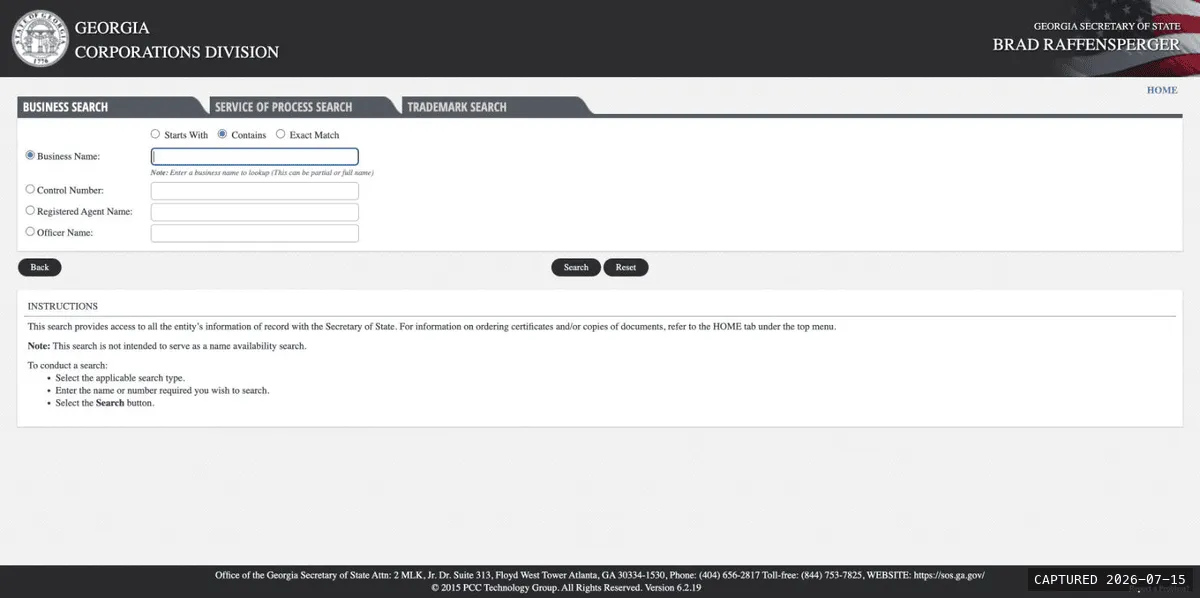
Your name must include "LLC" or "L.L.C." and be distinguishable from existing Georgia entities. Run it through the Corporations Division business search on eCorp first: it lists every registered Georgia entity by name, and the page itself notes it is not the official availability check. The Corporations Division makes that call when you file, so a close match here is your signal to pick something more distinct.
Georgia requires a registered agent with a physical street address in the state, available during business hours. You can serve yourself, which puts your address on the public record. A commercial agent keeps your home address off the filing.
File online through the eCorp portal: from the home page, "Online Services" is the entry point, and the filing itself continues behind a user account. The online filing fee is $100, paid by card, and covers the Articles of Organization (Form CD 030). Standard online processing runs about 5–7 business days; expedited service is available for an extra fee.
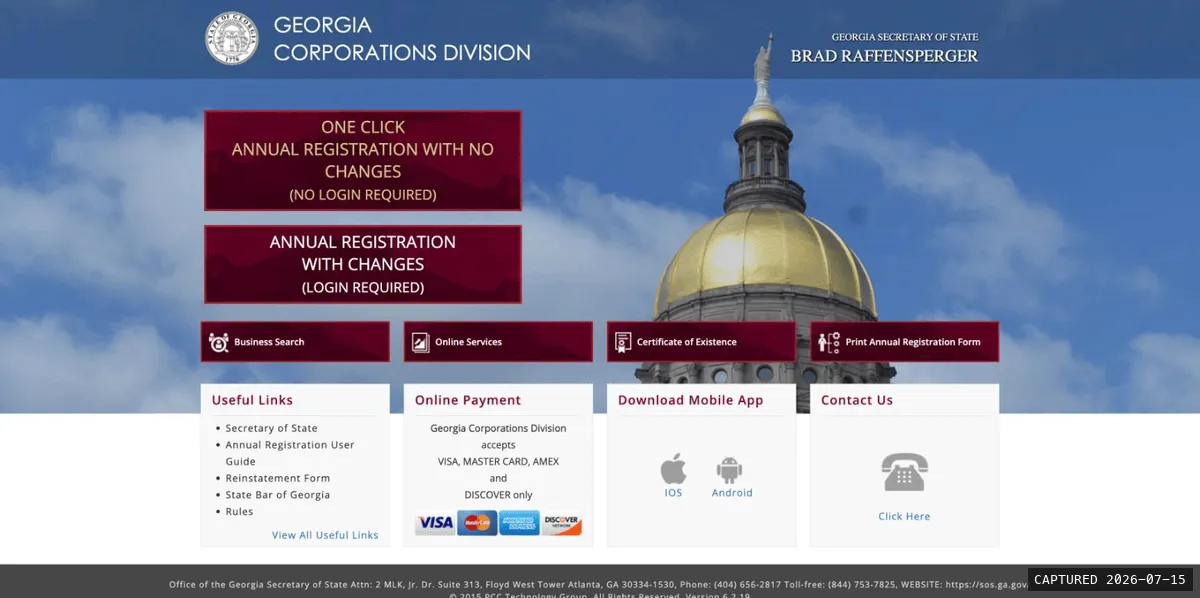
Apply for an Employer Identification Number on the IRS website once the LLC is approved. It is free and takes about ten minutes online; you need it for banking, hiring, and taxes. Ignore any site that charges for an EIN.
Georgia doesn't require an operating agreement, but it is the document banks, landlords, and partners ask for. A short standard agreement works for a single-member LLC; multi-member LLCs should put splits and exit terms in writing from day one.
Georgia has no general statewide business license; instead, nearly every city and county requires an occupation tax certificate (local business license) before you operate. For construction specifically: Georgia licenses through the State Licensing Board for Residential and Commercial General Contractors, in four categories. Residential Basic and Residential Light Commercial each ask a minimum net worth of $25,000, with general liability of $300,000 and $500,000 per occurrence. Commercial General Contractor asks $150,000 of net worth and $500,000 of liability. Commercial General Contractor Limited Tier asks $25,000 and $500,000 and is the only category with a project cap, at $1 million. A residential-basic applicant also has to be 21, show two years of experience predominantly in that category and significant responsibility for at least two projects in the two years before applying, and pass the exam. The license is issued to the person, who then qualifies the business organization.
Georgia LLCs file an annual registration with the Secretary of State between January 1 and April 1 ($50 online). Open a separate business bank account with your filed articles and EIN so personal and business finances never mix.
Same state fee either way. The difference is your time, and whose address goes on the public record.
The board's own warranty rule sets the measure. A covered contract is any contract to construct, superintend or manage the construction of a single family residence where the total value of the work or the compensation you receive, whichever is greater, exceeds $2,500. Repair work sits outside the licensing chapter on conditions, and the specialty trades run under a separate chapter that the repair exception does not touch.
No. Georgia issues the license to an individual, and a business organization contracts in its own name through that person acting as its qualifying agent. The individual's application lists every person, entity and business organization they will be affiliated with, and the general liability cover is carried in the individual's name. One person can qualify several companies and a company can have several qualifying agents. If the agent leaves, the board wants notice within 30 days and the company then has 180 days to complete open contracts before its license number goes inactive.
Yes. Any Georgia resident over 18 with a physical street address in the state can serve as the agent, including yourself. The trade-off is that the agent's address is public and someone must be available there during business hours to accept service of process.
The $100 online fee files the Articles of Organization and creates the LLC. It does not include the annual registration Georgia requires each year ($50 online), an EIN (free from the IRS), or the local occupation tax certificate your city or county issues.
Source: BusinessFormation.us analysis of U.S. Census Bureau
County Business Patterns 2023 and Nonemployer Statistics 2023
(establishment counts, NAICS 2361), and Business Formation
Statistics (monthly applications); retrieved Jul 2026.
businessformation.us/start/construction-company/georgia/