WITH EMPLOYEES
8,062
U.S. CENSUS CBP 2023
 U.S. FORMATION DATA & GUIDES
 To start a construction company in Illinois you'll file Articles of Organization with the Secretary of State ($150) and get a free EIN from the IRS. The trade layer and the general contractor layer sit in different governments here. Illinois licenses roofing contractors statewide through the Department of Financial and Professional Regulation, with a $10,000 bond and a named qualifying party, while the general contractor license in Chicago comes from the Department of Buildings in five classes by project value, from $500,000 up to unlimited. State law also puts your license number on every contract, bid and permit application. Total state LLC filing: ~$150 and a $75 annual report.
195,475 new business applications in Illinois (last 12 mo) ▲ 15% YoY
Illinois splits the question in a way none of the other states in this pilot do. The trade licenses and the general contractor license come from different governments. The Department of Financial and Professional Regulation licenses roofing contractors for the whole state, so a roofer in Rockford and a roofer in Chicago hold the same credential from the same agency. The general contractor license is a city document, and in Chicago it is issued by the Department of Buildings. A company that frames houses and a company that replaces roofs therefore deal with two different regulators, on two different schedules, for the same house.
The roofing license runs in two classes. A limited license covers residential roofing, including residential properties of eight units or fewer, and an unlimited license covers residential and commercial work without that restriction. Either way the application designates a qualifying party: the sole proprietor, a partner, an officer of a corporation or the equivalent party in another legal entity, who is legally qualified to act for the business in all matters connected with its roofing work, has authority to supervise installation, and is actively engaged in the day to day activities of the business. The bond is $10,000 in the aggregate, from a company licensed to do business in Illinois, and the department accepts proof of liability and property damage insurance only on its own form.
State law then reaches into the paperwork of the job, which is the part a new company is most likely to get wrong. A state-licensed roofing contractor has to put the license number and the licensee’s name on every contract, every bid, every application for a building permit and every permit issued and recorded. A contractor offering home repair or remodeling services may not advertise or promise to pay or rebate any part of an insurance deductible as an inducement to a sale. Licenses may never be lent, paid for or not, and a contractor may not take compensation for letting an out-of-area contractor work under its name or number. On any contract over $1,000 the consumer rights brochure goes to the customer with specific required language.
After a catastrophe the rules tighten again, and roofing companies meet them constantly. Where a natural event damages more than one residence, a customer who has signed a written contract may cancel within five business days of learning from their insurer that the claim is not covered, or by the thirtieth business day after the insurer receives a properly executed proof of loss, and that right has to appear in the contract in at least 10 point boldface. The contractor then returns any payments, deposits or notes. The contractor also may not represent the homeowner on the insurance claim, may not offer or advertise to do so, and may not call in or file the claim on the homeowner’s behalf. The business that chases storms and handles the claim for the customer is describing conduct Illinois wrote a law to stop.
Chicago’s license is graded by the size of the job, and the measure is the whole site rather than your share of it. The value of a project is the fair market value of materials and labor provided by all contractors and subcontractors across all concurrent and consecutive regulated activities at the same site. Class E covers projects to $500,000 with $1 million of insurance per occurrence and no demolition. Class D reaches $4 million and Class C $10 million, both for ordinary demolition, at $2 million of insurance. Class B reaches $20 million with $3 million of insurance and complex demolition, and Class A has no project limit at $5 million. Policies come from an insurer rated B+ or better by A.M. Best.
Those numbers changed recently, so check any guide’s figures against the date on them. The Department of Buildings updated general contractor licensing on 6 January 2026: annual fees rose for Classes A through D, the first increase since 2003, project limits for Classes B, C and D doubled, and the insurance minimum for Classes C and D moved to $2 million per occurrence, enforced for existing holders when the policy on file expires. Class E kept its fee and its $500,000 limit. From 2027 the fees adjust each year with the Consumer Price Index.
The entity question gets its eighth answer, and Chicago’s is short: licenses are issued to businesses, including sole proprietorships. An LLC applying supplies identification for its managing member and for anyone else who signed the application, a statement of financial solvency, proof that it is authorized to do business in Illinois, and an assumed name certificate if it trades under one. Two limits are worth planning around. Only one general contractor is allowed on a project at a time, whatever the permit count. And the exemption that lets someone act as their own general contractor belongs to an individual, on an entirely residential property that is their own primary residence, capped at six units and three stories, usable for one property a calendar year, and never for work needing a demolition permit or an excavation notice. Putting that property into an LLC takes the exemption away.
The counts on the plate above give Illinois the smallest construction firms of any state in this pilot, averaging under three employees at the firms that have payroll at all. Set that against a license system whose entry class already covers half a million dollars of work and whose top class is unlimited. The classes are calibrated for a market far above the typical Illinois construction company, which is the usual shape of a city license: written for the projects the city worries about, applied to everyone who pulls a permit.
Your name must include "LLC" or "L.L.C." and be distinguishable from entities already on file in Illinois. Run it through the Secretary of State's business entity search at ilsos.gov before filing so a conflict does not cost you the fee.
Illinois requires a registered agent with a physical street address in the state, available during business hours. You can serve yourself, which puts your address on the public record. A commercial agent lists theirs instead.
File online at ilsos.gov and pay the $150 state fee by card. Standard online processing runs 5–10 business days; a 24-hour expedite is available for an extra $100.
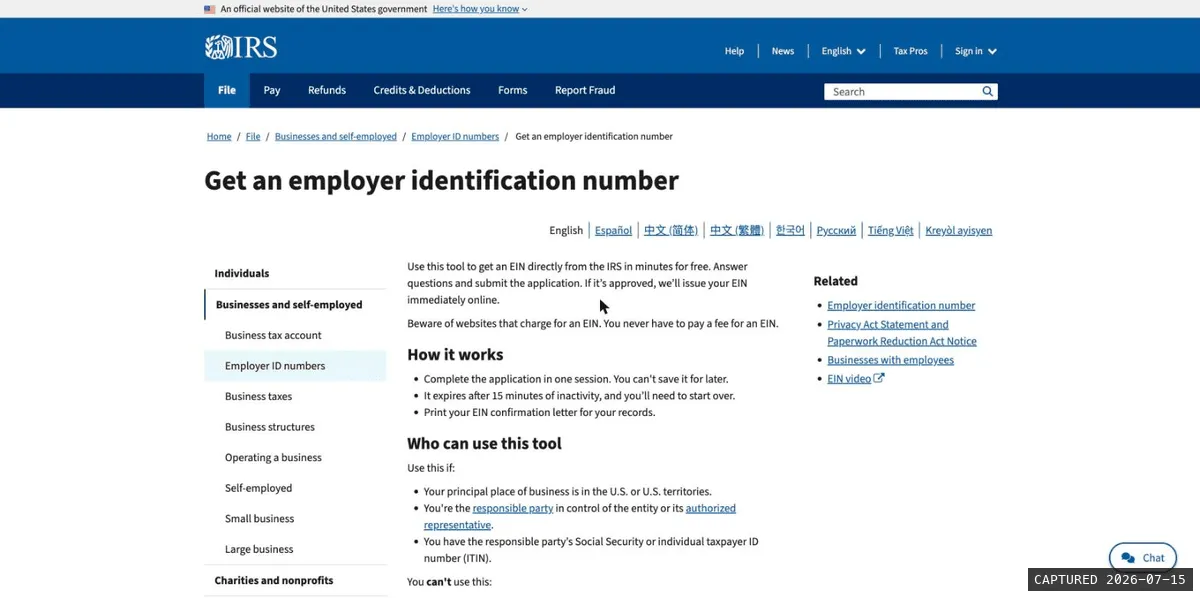
Apply for an Employer Identification Number on the IRS website once the LLC is approved. It is free and takes about ten minutes online; you need it for banking, hiring, and taxes. Ignore any site that charges for an EIN.
Illinois does not require an operating agreement, but banks routinely ask for one and it fixes ownership and profit splits in writing. A single-member LLC can use a short standard form; multi-member LLCs should document splits and exit terms.
Illinois has no general statewide business license. Chicago and many other municipalities license businesses locally; check the rules for every city where you take jobs. For construction specifically: Illinois licenses roofing contractors at state level through the Department of Financial and Professional Regulation, in a limited class for residential work up to eight units and an unlimited class covering residential and commercial, each requiring a $10,000 bond, insurance on the department's own form, and a designated qualifying party who is actively engaged in the business day to day. The general contractor license is a city matter. Chicago issues five classes by project value, from Class E at $500,000 with $1 million of insurance to Class A with no project limit and $5 million, and it licenses the business rather than a person.
Illinois LLCs file an annual report (Form LLC-50.1, $75) due before the first day of the LLC's anniversary month; filing 60 or more days late adds a $100 penalty. Open a dedicated business bank account with your filed articles and EIN to keep liability protection intact.
Same state fee either way. The difference is your time, and whose address goes on the public record.
The general contractor license is issued by the city rather than the state. In Chicago a licensed and insured general contractor is required for most building construction, rehabilitation and demolition work, and only one general contractor is allowed on a project at a time no matter how many permits are issued. The state licenses specific trades instead, including roofing, which is licensed by the Department of Financial and Professional Regulation everywhere in Illinois.
No. The exemption belongs to an individual working on an entirely residential property that is their own primary residence, shown on a driver's license or similar government ID, with no more than six residential units and nothing taller than three stories, and it can be claimed for only one property in a calendar year. It does not cover work needing a demolition permit or an excavation notice. Holding the property in an LLC puts the work outside it.
Yes. Any Illinois resident with a physical street address in the state can serve, including yourself. The agent's name and address go on the public record, and someone must be available there during business hours to accept legal documents. Those are the reasons owners hire a commercial agent.
The $150 files the Articles of Organization (Form LLC-5.5) and creates the LLC. It does not include the $75 annual report Illinois requires before each anniversary month, an EIN (free from the IRS), or any local license your city requires. Filing the annual report 60 or more days late adds a $100 penalty.
Source: BusinessFormation.us analysis of U.S. Census Bureau
County Business Patterns 2023 and Nonemployer Statistics 2023
(establishment counts, NAICS 2361), and Business Formation
Statistics (monthly applications); retrieved Jul 2026.
businessformation.us/start/construction-company/illinois/