WITH EMPLOYEES
6,505
U.S. CENSUS CBP 2023
 U.S. FORMATION DATA & GUIDES
 To start a construction company in New Jersey you'll file a Certificate of Formation with the Division of Revenue ($125) and get a free EIN from the IRS. Residential work then needs a home improvement contractor business registration from the Division of Consumer Affairs, $110 to apply and $90 to renew each March, with no exam and no experience requirement. What the state checks instead is money: general liability insurance of at least $500,000 per occurrence, workers' compensation unless the business is exempt, and additional security of $10,000, $25,000 or $50,000 set by the size of the contracts you take. Total state LLC filing: ~$125 and 1–3 business days.
170,353 new business applications in New Jersey (last 12 mo) ▲ 11% YoY
New Jersey does not test construction contractors. There is no state exam, no experience requirement, and no competency board handing out a credential the way California, Florida and North Carolina do. What the state runs instead is a consumer-protection registration, and the law behind it was rewritten in January 2024. P.L. 2023, c. 237 amended the Contractors’ Business Registration Act, and the change starts with the name on the certificate: the registrant is now a home improvement contractor business rather than a home improvement contractor. The Division of Consumer Affairs registers the company, not a person inside it.
That registration asks for money rather than skill. Applying costs $110 and renewing costs $90, online between mid-January and the end of March, with a $25 late fee through April and expiry on 31 March each year. Three financial proofs go with it and two of them are new since the amendment. The business carries commercial general liability insurance of at least $500,000 per occurrence. It carries workers’ compensation insurance unless it is exempt by law, with documentation of the exemption if it claims one. And it maintains additional security under N.J.S.A. 56:8-142, meaning a compliance bond, an irrevocable letter of credit, or securities or money, at one of three amounts. $10,000 covers a business whose contracts run under $10,000 each or under $150,000 across the previous 12 months. $25,000 covers a contract between $10,000 and $120,000, or a year between $150,000 and $750,000. $50,000 applies above $120,000 on a single contract or $750,000 across the year. Third-party guides often print the middle band as $10,000 to $25,000. The Division’s own notice to registrants says $120,000.
Whose registration it is has the shortest answer in this pilot. It is the company’s, outright. The application takes the business name from the Certificate of Formation and requires the two to match, asks an LLC for a New Jersey agent authorized to accept service of process, and lists every owner holding 10 percent or more. Nobody is examined, so nobody’s departure suspends anything. North Carolina freezes a license the day its qualifier leaves and Florida makes the LLC contract on a person’s certificate. New Jersey has nothing of that shape to freeze. The 2024 law does create a State Board of Home Improvement and Home Elevation Contractors, along with a license renewing every two years that would change this answer once it starts.
Workers’ compensation is where the entity choice does real work here, and it runs against the usual intuition. The Department of Labor’s employer guide is explicit that an LLC must carry coverage once one or more individuals, excluding its own members, are paid for services. Members are not counted, so an owner-only crew has nobody to cover. A corporation gets no such treatment: every corporation must carry coverage as long as anyone including a corporate officer is paid, with no minimum payroll and no single-officer exemption. Whether a helper on the job counts as an employee is decided by the courts’ control test and relative nature of the work test, and a paper calling someone an independent contractor does not settle it. The consequences are why the question matters. Failing to insure is a disorderly persons offense, a willful failure is a crime of the fourth degree, penalties run to $1,000 for the first 20 days and another $1,000 for each 10 days after that, and where an injury has occurred the members of an LLC are personally liable for the benefits. That is one of the few places where forming an LLC does not stand between the business and the people who own it.
One registration does not cover the whole trade. Home improvement work on residential property is the Division of Consumer Affairs registration above. Building new homes is a separate registration with the Department of Community Affairs, a different agency with a similar name, under the New Home Warranty and Builders’ Registration Act. A builder registers before starting construction on any new home and before offering a warranty on one, pays $200, renews every two years, and faces fines up to $2,000 with each home sold while unregistered counted as its own offense. Public work is a third door. Bidding on or performing a public project takes a Public Works Contractor Registration from the Division of Wage and Hour Compliance at the Department of Labor, $500 for one year or $750 for two. A company that remodels kitchens, builds spec houses and takes municipal contracts holds three registrations and still sits no exam.
The counts on the plate above put New Jersey at roughly three solo operators for every construction firm with payroll, close to North Carolina and California and well under half of Texas. The figure underneath it is the more useful one. New Jersey’s firms with payroll average under four employees each, where California and Texas run near five, so the typical registrant here is a small crew rather than a contracting company with departments. The banded security lands squarely on that population. The lowest tier is written for a business whose year runs under $150,000, and the $500,000 insurance floor does not move with size at all.
Your name must include "LLC" or "L.L.C." and be distinguishable from entities already registered in New Jersey. Check availability through the state's business name search before you file; a conflicting name gets the filing rejected.
New Jersey requires a registered agent with a street address in the state, available during business hours. You can serve yourself, which puts your address on the public record. A commercial agent lists theirs instead.
File online through the Division of Revenue's Business Formation portal at njportal.com and pay the $125 fee by card. Online filings are typically processed in 1–3 business days; an over-the-counter expedite costs $25.
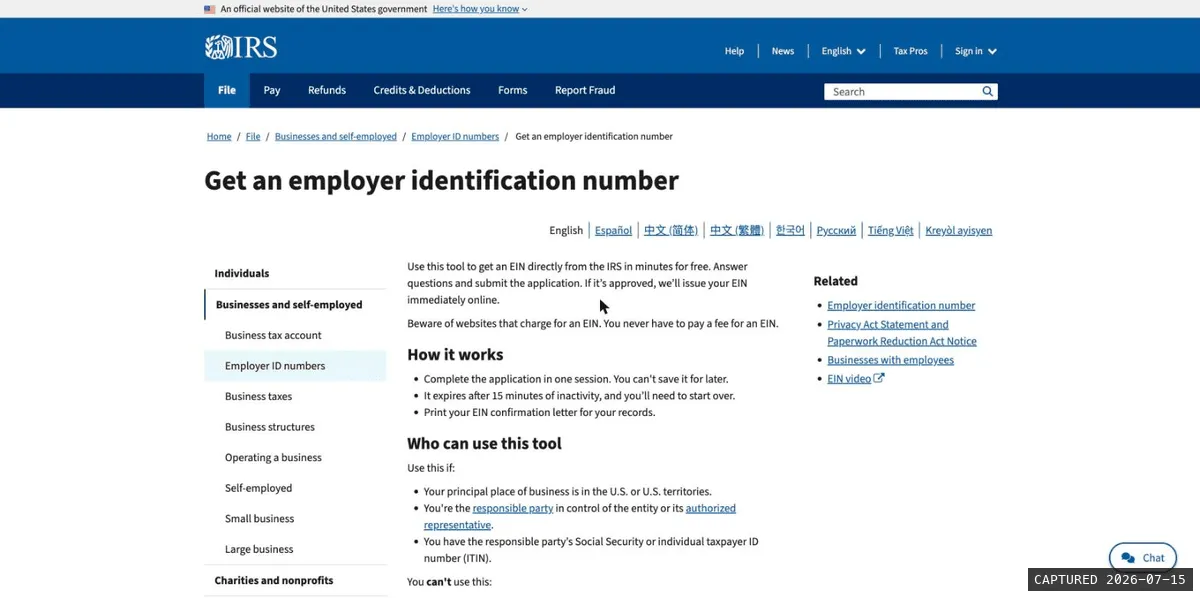
Apply for an Employer Identification Number on the IRS website once the LLC is approved. It is free and takes about ten minutes online; you need it for banking, hiring, and taxes. Ignore any site that charges for an EIN.
New Jersey requires every business to register for tax purposes with the Division of Revenue and Enterprise Services after formation. The registration is free, uses your EIN, and the same njportal.com flow offers it right after the formation filing. Complete it before you collect sales tax or hire.
New Jersey does not require an operating agreement, but banks routinely ask for one and it fixes ownership and profit splits in writing. A single-member LLC can use a short standard form; multi-member LLCs should document splits and exit terms.
New Jersey has no general statewide business license. State boards license specific occupations, and municipalities add their own permits; check the rules where the work actually happens. For construction specifically: New Jersey does not test contractors. The Division of Consumer Affairs registers the business, and since P.L. 2023, c. 237 the registrant is formally a home improvement contractor business rather than a home improvement contractor. Registration costs $110 to apply and $90 to renew in the January to March window, and it now takes three financial proofs. Commercial general liability insurance of at least $500,000 per occurrence, workers' compensation insurance unless the business is exempt by law, and additional security in the form of a compliance bond, an irrevocable letter of credit, or securities or money, at $10,000, $25,000 or $50,000 by contract size. New home construction and public works each carry a separate registration with a different agency.
New Jersey LLCs file an annual report ($75) due by the last day of the LLC's anniversary month each year. Open a dedicated business bank account with your filed certificate and EIN to keep liability protection intact.
Same state fee either way. The difference is your time, and whose address goes on the public record.
No. The home improvement contractor business registration has no exam and no experience requirement. The Division of Consumer Affairs checks the business documents, the owners at 10 percent or more, liability insurance, workers' compensation, and the additional security, then issues a registration number. The 2024 law created a State Board of Home Improvement and Home Elevation Contractors and a future license that would renew every two years. The board publishes no start date for it, and registration is what the Division issues now.
Members of an LLC are not counted as employees, so an owner-only crew has nobody to cover and can document that exemption on the registration application. A corporation gets no equivalent: coverage attaches as soon as any individual including a corporate officer is paid, with no minimum payroll and no single-officer exemption. Failing to insure is a disorderly persons offense, and where an injury has occurred the members of an LLC are directly liable themselves.
Yes. Any New Jersey resident with a street address in the state can serve, including yourself. The agent's name and address go on the public record, and someone must be available there during business hours to accept legal documents. Those are the reasons owners hire a commercial agent.
The $125 files the Certificate of Formation and creates the LLC. It does not include the free but mandatory state tax registration, an EIN (free from the IRS), or the $75 annual report due by the last day of your anniversary month every year.
Source: BusinessFormation.us analysis of U.S. Census Bureau
County Business Patterns 2023 and Nonemployer Statistics 2023
(establishment counts, NAICS 2361), and Business Formation
Statistics (monthly applications); retrieved Jul 2026.
businessformation.us/start/construction-company/new-jersey/