WITH EMPLOYEES
17,061
U.S. CENSUS CBP 2023
 U.S. FORMATION DATA & GUIDES
 To start a construction company in New York you'll file Articles of Organization through NY Business Express ($200), publish a formation notice in two county newspapers, and get a free EIN from the IRS. In New York City the credential you need is decided by the work rather than by the price of the job. Remodeling a 1- to 4-family home or a condo or co-op takes a Home Improvement Contractor license from the Department of Consumer and Worker Protection, with an exam, fingerprints and a $20,000 surety bond or trust fund enrollment. Building a new 1- to 3-family home takes a General Contractor Registration from the Department of Buildings instead, at $300 for three years. Total state LLC filing: $200 plus county-dependent publication costs.
313,942 new business applications in New York (last 12 mo) ▲ 9% YoY
New York City decides which credential a construction company needs by looking at the work, not at the price of the job. There is no threshold to cross the way North Carolina sets one at $40,000 and Pennsylvania at $5,000 of the previous year. The Department of Buildings publishes a map instead. A new 1- to 3-family home needs a General Contractor Registration. Any other new building needs a Safety Registration Number with a Construction Endorsement, or the General Contractor Registration. An alteration adding more than 25% to the floor area, or three or more stories, needs the same pair of options, and one removing more than 50% of the floor area or a story needs a Demolition Endorsement. Placing 2,000 yards of concrete or more needs a Concrete Endorsement. All other alteration work needs an Insurance Tracking Number at minimum. And work inside a 1-, 2-, 3- or 4-family home or a condo or co-op needs a Home Improvement Contractor license, which the Department of Buildings does not issue at all.
That last one is the split worth planning around. The Home Improvement Contractor license comes from the Department of Consumer and Worker Protection, a different agency with its own application, its own fee schedule and its own phone number. A company that builds spec houses and remodels kitchens is registered with Buildings for one line of work and licensed by Consumer and Worker Protection for the other. The General Contractor Registration itself is the simpler of the two: $300 to register, $240 to renew, $50 late, on a three-year term, and new applications have gone through the department’s online system since September 2021. Its form asks whether the business holds at least $25,000 in operating capital and lists every stakeholder with 10 percent or more. The insurance floor is $1,000,000 of general liability per occurrence, certified by the broker, plus workers’ compensation and disability cover. That last requirement is stricter than it looks: a general contractor registrant may not file the affidavit of exemption that other licensees use when a company has no employees, where a home improvement license at the other agency does accept a state exemption certificate. The same crew is exempt on one credential and not on the other.
The home improvement license is where the real conditions sit. A person or business must hold one to do construction, repair, remodeling or other home improvement work on any residential land or building in the city, and the department reads that broadly enough to include driveways, fences, garages, landscaping, patios, porches, sidewalks, swimming pools and terraces next to a home. The application asks for a $20,000 surety bond, or enrollment in the department’s trust fund at $200, where participants stop paying that fee at renewal for as long as the fund holds more than $2,000,000. It asks for proof of workers’ compensation insurance naming the department as certificate holder at its own Broadway address, or a Certificate of Attestation of Exemption from the state board, and it will not accept an ACORD form as proof. It asks for EPA Renovation, Repair and Painting certification and lead abatement certification, or a signed affirmation that the work does not require them. And it asks for a signed Contractual Compliance Agreement, because the department also sets what the contract itself has to say.
The entity question gets its sixth answer here, and New York splits it down the middle. Exactly one person needs to pass the exam. A sole proprietor, general partner, corporate officer, principal, director, member or shareholder owning 10% or more of the company may be the one, and the department asks you to confirm which. The exam runs 30 questions, needs 21 correct, costs $50 on top of the license fee, has to be taken within 60 days of your application clearing and is paid for again after a second failure. Fingerprinting works the other way: all of those people are printed, not just the one who sat the exam. On top of that, a limited liability company has to register and stay active with the New York State Division of Corporations to keep the license, which ties the formation filing to the trade credential the way California does. One member carries the exam, every member over 10% carries a background check, and the company carries the license.
The license fee is a calendar rather than a term, which is the detail that catches people. Every home improvement license in the city expires on 28 February of an odd year, so the term you buy depends on when you apply into that cycle. Applying between March and August of an odd year costs $100 and runs up to 24 months. September of an odd year through February of an even year costs $75 for up to 18 months. March to August of an even year costs $50 for up to 12 months. From September of an even year you choose: $25 for a stub of up to 6 months, or $125 for up to 30 months. The cheapest license is not the cheapest per month, and a company formed in the wrong half of the cycle pays twice inside three years.
The counts on the plate above give New York the fewest solo operators per construction firm with payroll of any state in this pilot, closer to two and a half where Texas runs near eight, and its payroll firms are small, averaging under four employees each. The credential map above is also the most demanding in the pilot: an exam, a bond, fingerprints and a separate registration for new construction, against states where a residential remodeler meets no regulator until a permit is pulled. These counts cannot show that one produced the other. They do show that the market with the highest barrier to a one-person start has the fewest one-person starts in it.
Your name must include "LLC" or "L.L.C." and be distinguishable from entities already on file. Search the Department of State's Corporation and Business Entity Database before filing. A conflicting name gets the filing rejected.
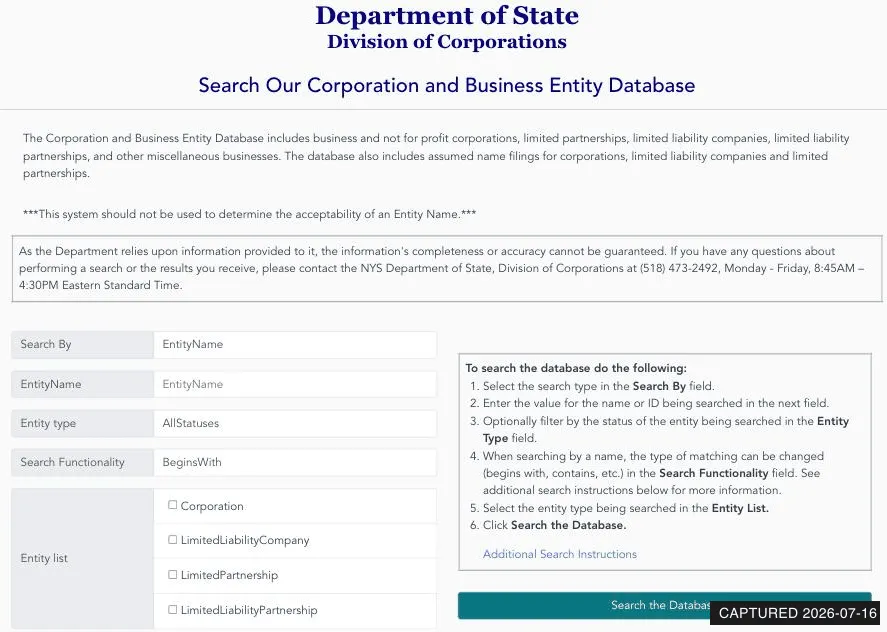
New York automatically designates the Secretary of State as every LLC's agent for service of process. You list an address where the state forwards legal papers; that address becomes part of the public record. Hiring a commercial registered agent is optional and keeps your home address off the filing.
Start at NY Business Express, the state's guide to filing; from there, online filing continues behind a Login/Register account. The state fee is $200 by card. Online filings submitted during business hours are usually processed the same day; mail filings run about 7 business days.
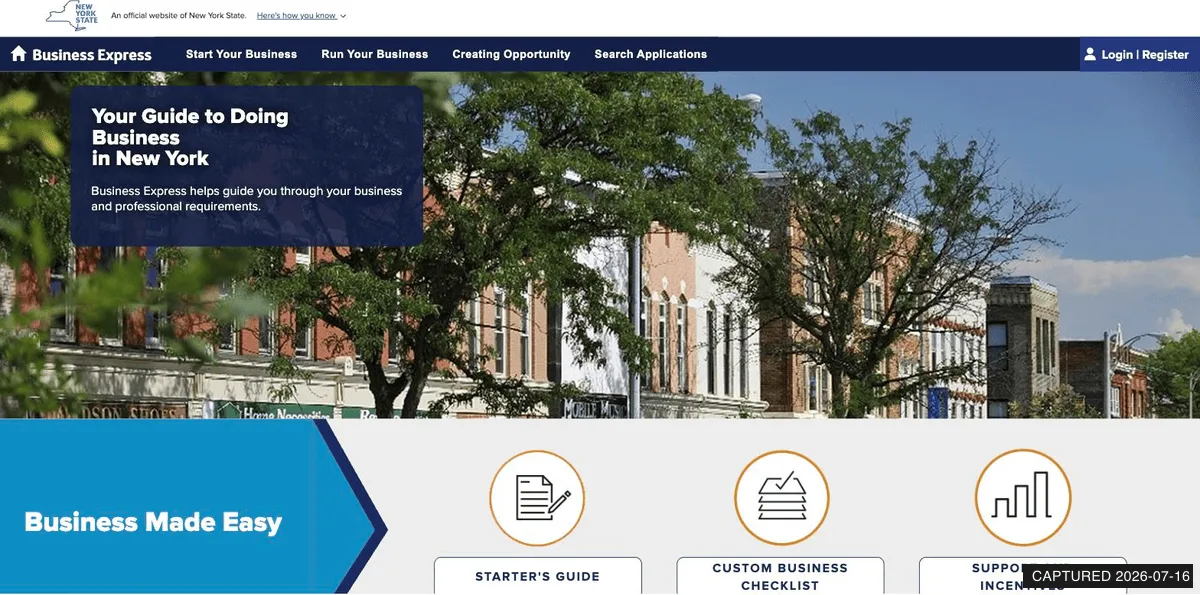
Within 120 days of formation, New York requires you to publish a notice in two newspapers designated by the clerk of the county where the LLC's office sits, once a week for six consecutive weeks, then file a Certificate of Publication with a $50 fee. Newspaper rates vary by county; New York City counties are the expensive end. Missing the deadline suspends the LLC's authority to do business in the state.
Apply for an Employer Identification Number on the IRS website once the LLC is approved. It is free and takes about ten minutes online; you need it for banking, hiring, and taxes. Ignore any site that charges for an EIN.
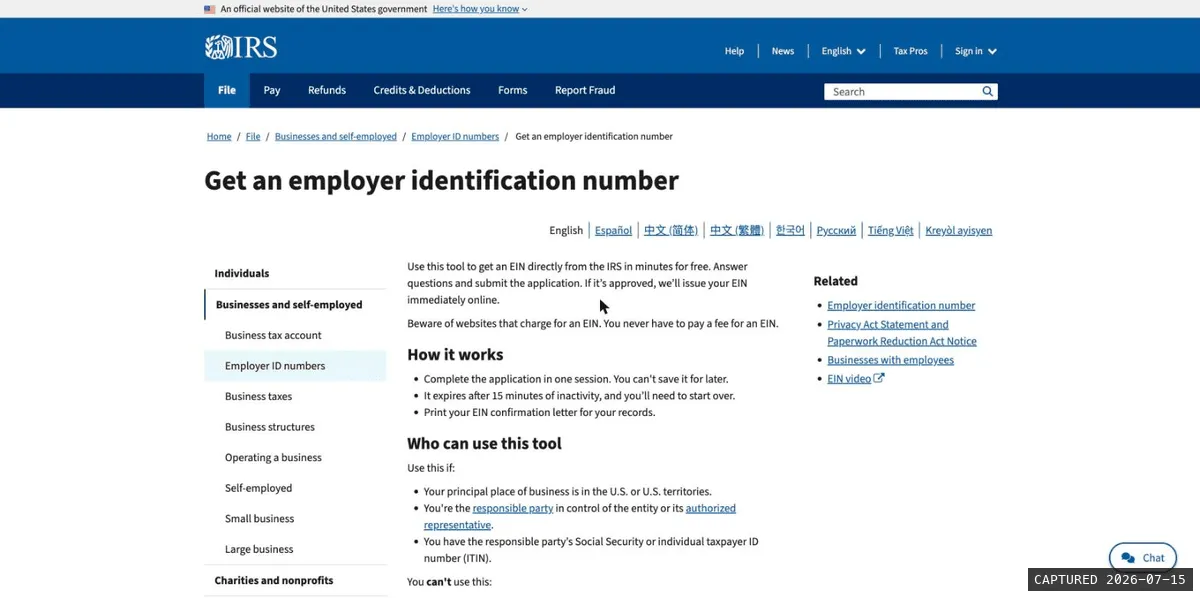
New York is one of the few states that requires LLC members to adopt a written operating agreement, before, at, or within 90 days of filing. It is not submitted to the state; you keep it with your records. Multi-member LLCs should document splits and exit terms in it from day one.
New York has no general statewide business license. New York City and many other municipalities run their own licensing and permit systems; check the rules where the work actually happens. For construction specifically: in New York City the Department of Buildings maps work types to credentials rather than setting a dollar threshold. A new 1- to 3-family home needs a General Contractor Registration, $300 to register and $240 to renew on a three-year term. Work in a 1-, 2-, 3- or 4-family home or a condo or co-op needs a Home Improvement Contractor license from a different agency, the Department of Consumer and Worker Protection, which takes a 30-question exam, fingerprints for every principal, a $20,000 surety bond or trust fund enrollment, workers' compensation proof naming the department, and EPA lead certifications or a signed affirmation that neither applies. Larger alterations, demolition, excavation and big concrete pours each need a Safety Registration with the matching endorsement.
Every two years, in the calendar month the LLC was formed, New York requires a biennial statement with a $9 fee, filed through the Department of State's e-Statement service. Open a dedicated business bank account with your filed articles and EIN to keep liability protection intact.
Same state fee either way. The difference is your time, and whose address goes on the public record.
Only if it does both kinds of work. The Department of Buildings assigns credentials by work type: building a new 1- to 3-family home takes a General Contractor Registration, while work inside an existing 1-, 2-, 3- or 4-family home or a condo or co-op takes a Home Improvement Contractor license from the Department of Consumer and Worker Protection. A company that builds spec houses and also remodels kitchens holds both, from two separate agencies with two separate applications.
Exactly one person. A sole proprietor, general partner, corporate officer, principal, director, member or shareholder owning 10% or more may sit the 30-question Home Improvement Exam, and the department asks you to confirm which one it will be. Fingerprinting is the opposite: every one of those people has to be printed. The exam costs $50 on top of the license fee, needs 21 correct answers, has to be taken within 60 days, and is paid for again after a second failure.
The state's own fee is $50 for the Certificate of Publication. The real cost is the newspaper notices, which run for six weeks in two papers the county clerk designates, and those rates vary widely by county. Upstate counties are the cheap end; New York City counties cost the most. Skipping it suspends the LLC's authority to do business.
Not as a separate hire. The Secretary of State is automatically the agent for service of process for every New York LLC; you just supply a forwarding address on the filing. A commercial registered agent is optional. Owners use one to keep a home address off the public record.
Source: BusinessFormation.us analysis of U.S. Census Bureau
County Business Patterns 2023 and Nonemployer Statistics 2023
(establishment counts, NAICS 2361), and Business Formation
Statistics (monthly applications); retrieved Jul 2026.
businessformation.us/start/construction-company/new-york/