WITH EMPLOYEES
8,063
U.S. CENSUS CBP 2023
 U.S. FORMATION DATA & GUIDES
 To start a construction company in North Carolina you'll file Articles of Organization with the Secretary of State ($125) and get a free EIN from the IRS. The building work is licensed by the Licensing Board for General Contractors once the cost of the undertaking reaches $40,000, and the license has to be in place before you bid rather than before you build. The license is issued to the company, but it rests on one individual who passed the board's exam. If that person leaves, the company may take no new contracts and the license is invalidated after 90 days. Total state LLC filing: ~$125 and 15–20 business days.
196,775 new business applications in North Carolina (last 12 mo) ▲ 22% YoY
North Carolina draws its licensing line at a figure high enough that real construction work sits under it, then measures that figure in a way which catches more work than it first appears to. The Licensing Board for General Contractors licenses anyone who bids on, constructs, or superintends a building where the cost of the undertaking is $40,000 or more. That is the cost of the whole undertaking and not the amount you invoice, so a $30,000 labor package on a $250,000 build is licensed work. The duty also attaches to the bid. Bidding on that job unlicensed is a Class 2 misdemeanor before anyone breaks ground, and an architect or engineer who recommends an unlicensed bidder for the award commits the same offense.
Enforcement sits at the permit counter, which is why the licensing rule and the insurance rule arrive together. A building inspector may not issue a permit for work costing $40,000 or more until the applicant proves that the work will be run by a licensee or by someone exempt, and produces evidence of the workers’ compensation coverage Chapter 97 requires of them. An inspector who issues one anyway commits a Class 3 misdemeanor. An owner building for their own occupancy signs a sworn affidavit instead, promising to superintend every aspect of the job personally and to attend every inspection the building code calls for, and the board verifies the claim afterwards. If the building is not occupied by that owner for 12 months after completion, the exemption is presumed not to have applied and the permit can be revoked.
Whose license it is has a two-part answer here, and neither part is the one California or Florida gives. The license is issued to the company. The qualification behind it belongs to an individual, the qualifier, and a partnership or corporation is licensed on the examination of a responsible managing officer or member of its personnel. So the entity holds the credential and cannot use it without that person on the payroll. When the qualifier leaves, new bids and new contracts stop that day, the license runs 90 more days and then goes invalid, and the licensee has to return to active status under the board’s rules. Name the qualifier in the operating agreement and treat a second examined person as succession planning rather than as paperwork.
The limitation you apply for is what prices the license. Limited, intermediate and unlimited cap a single project at $750,000, $1.5 million and nothing, with the cost of land and the work to improve it left out of the count. Each asks for working capital of $17,000, $75,000 or $150,000, meaning current assets over current liabilities, and the limited tier will take a total net worth of $80,000 instead. A surety bond of $175,000, $500,000 or $1,000,000 substitutes for the working capital at any tier and has to stay in force for as long as the license does. The paperwork gap is wider than the money gap. Both upper tiers need those figures in an audited financial statement or an agreed-upon procedures report prepared by an accountant, where a limited applicant self-reports unless a bankruptcy within the past five years pulls them into the same requirement. Fees are $75, $100 and $125 to apply, the same to renew, and every license expires on 1 January.
Workers’ compensation reaches a construction LLC through two separate rules. The general one starts at three employees, and members of an LLC are not automatically counted toward that number, which puts a small crew of owners below it. The construction-specific one has no threshold at all. A contractor who sublets any part of a job without first obtaining a certificate showing the subcontractor carries coverage becomes liable for that subcontractor’s injured employees, whether or not either company has three people. Collecting certificates before the sub starts is the cheapest insurance decision on the job.
The counts on the plate above put North Carolina close to California, at roughly three solo operators for every construction firm with payroll, where Texas runs near eight and Florida near six. What the licensing line adds is what those solo firms are allowed to do with themselves. At $40,000 a project, a North Carolina operator can run a genuine remodeling business under the threshold and never meet the board, where the same operator in California crosses their state’s line at $1,000 or at the first permit.
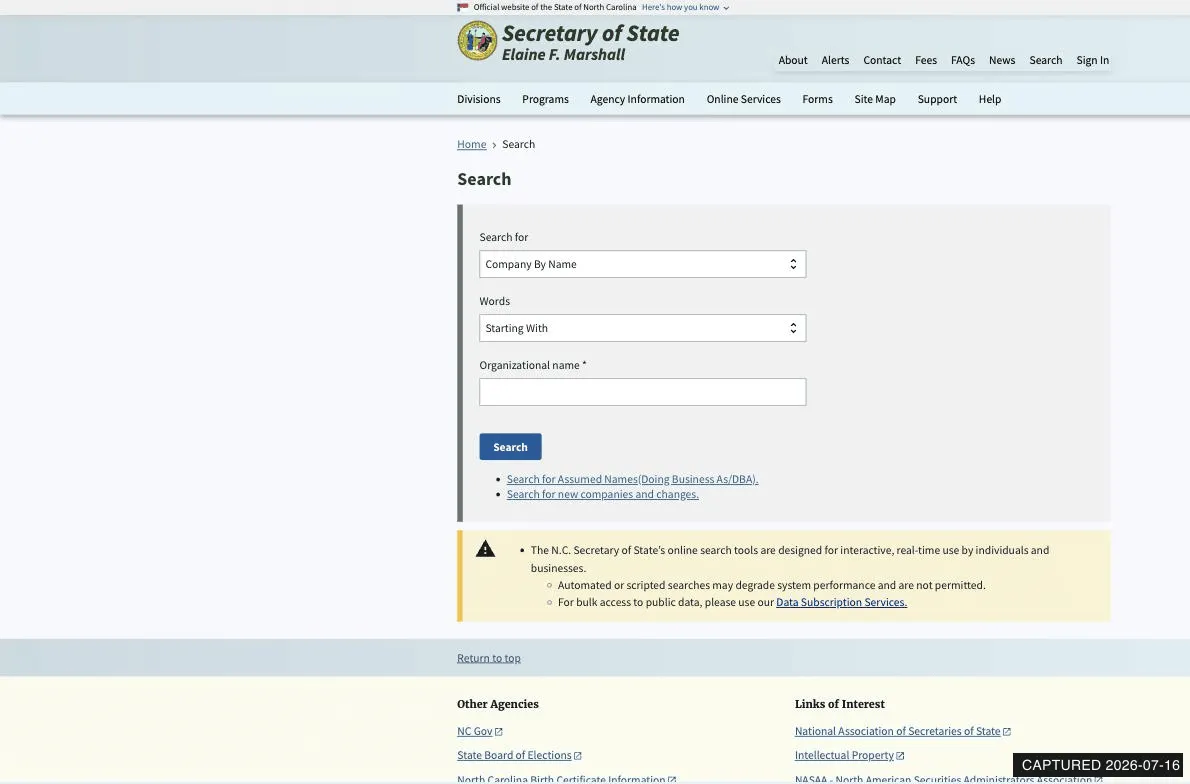
Your name must include "LLC" or "L.L.C." and be distinguishable from entities already registered in North Carolina. Search existing names through the Secretary of State's business search at sosnc.gov before you file; a conflict gets the filing rejected.
North Carolina requires a registered agent with a physical street address in the state, available during business hours. You can serve yourself, which puts your address on the public record. A commercial agent lists theirs instead.
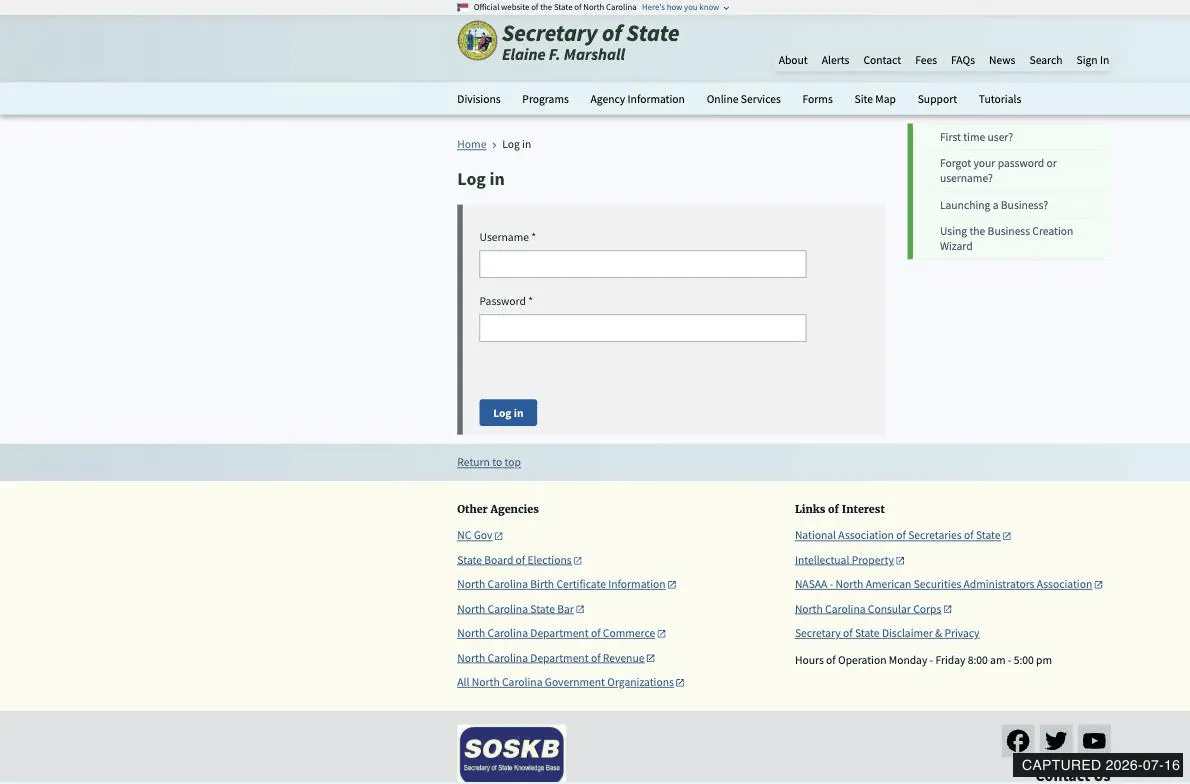
Start the Online Business Registration wizard at sosnc.gov and it redirects straight to a Log In screen, so the first real step is creating a free sosnc.gov account. From there the fee is $125 by card. The state's published turn-around for entity creation is 15–20 business days, with online the faster channel. If you cannot wait, $100 buys 24-hour processing and $200 same-day.
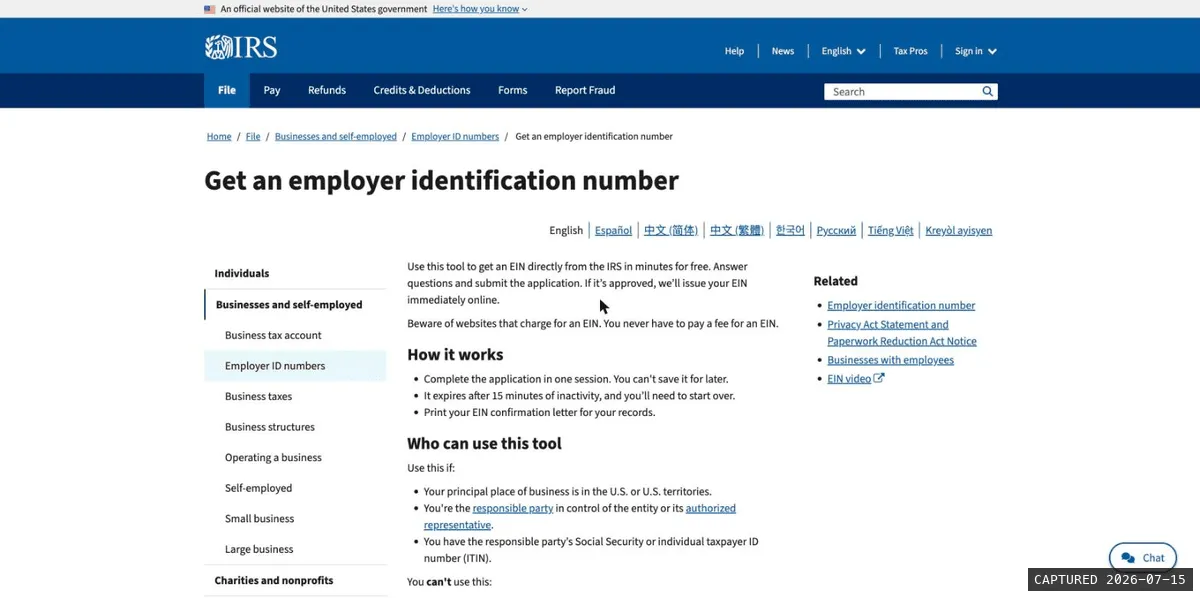
Apply for an Employer Identification Number on the IRS website once the LLC is approved. It is free and takes about ten minutes online; you need it for banking, hiring, and taxes. Ignore any site that charges for an EIN.
North Carolina does not require an operating agreement, but banks and partners ask for one and it settles ownership questions in writing. A single-member LLC can use a short standard agreement; multi-member LLCs should document splits and exit terms.
North Carolina has no single statewide business license. Requirements come from state occupational boards and from city or county rules; check both where the work actually happens. For construction specifically: North Carolina licenses general contractors through the Licensing Board for General Contractors, and the trigger is a project value of $40,000 or more, measured on the cost of the undertaking rather than on the fee you charge. Three limitations sit under one license. A limited license caps a single project at $750,000, an intermediate license at $1.5 million, and an unlimited license is not capped, with the cost of land excluded. Each tier carries a financial test of $17,000, $75,000 or $150,000 in working capital, replaceable by a surety bond of $175,000, $500,000 or $1,000,000. Application fees are $75, $100 and $125 by tier.
North Carolina LLCs file an annual report due April 15 each year after the year of creation: $203 filed online by card, $200 by paper. Open a dedicated business bank account with your filed articles and EIN to keep liability protection intact.
Same state fee either way. The difference is your time, and whose address goes on the public record.
Once the cost of the undertaking reaches $40,000. The statute measures the project, not the fee you charge, so a $30,000 framing contract on a $250,000 house is licensed work. The duty attaches at the bid rather than at the build: contracting for or bidding on work at or above that figure without a license is a Class 2 misdemeanor, and so is presenting someone else's license as your own.
The license belongs to the company, and the exam behind it belongs to a person the board calls the qualifier or qualifying party. If that person stops being connected with the licensee, the license stays in full force for 90 days and is then invalidated, and from the day they leave the company may not bid on or undertake any additional contracts. Work already under contract runs on. Getting a second person examined before the first one leaves is the only way to keep bidding through the gap.
The Secretary of State's published turn-around for entity creation is 15–20 business days, the slowest standard processing among the states we cover, and online filing is the faster channel. Paid expedite shortens it: $100 for 24-hour processing, $200 for same-day.
The state sets the LLC annual report fee at $200 ($203 filed online by card), the highest recurring state cost among the ten states in this pilot. It is due April 15 every year after the creation year. Late or skipped reports lead to administrative dissolution, so calendar it with your taxes.
Source: BusinessFormation.us analysis of U.S. Census Bureau
County Business Patterns 2023 and Nonemployer Statistics 2023
(establishment counts, NAICS 2361), and Business Formation
Statistics (monthly applications); retrieved Jul 2026.
businessformation.us/start/construction-company/north-carolina/