WITH EMPLOYEES
4,674
U.S. CENSUS CBP 2023
 U.S. FORMATION DATA & GUIDES
 To start a construction company in Ohio you'll file Articles of Organization with the Secretary of State ($99) and get a free EIN from the IRS, with no annual report to follow. Ohio issues no state general contractor license. The Construction Industry Licensing Board licenses five trades to individuals, and what binds a residential builder statewide is a contract statute instead: any home construction service costing $25,000 or more needs a written contract carrying nine specified items, including proof of at least $250,000 in general liability insurance, and the down payment is capped at 10 percent. Total state LLC filing: ~$99 and no recurring state fee.
181,365 new business applications in Ohio (last 12 mo) ▲ 24% YoY
Ohio answers the licensing question by mostly not asking it, then regulating the contract instead. There is no state general contractor license. The Construction Industry Licensing Board licenses five trades, heating and air conditioning, refrigeration, electrical, plumbing and hydronics, and a builder who frames houses and subcontracts those trades never meets the board. What does reach that builder, everywhere in the state, is Chapter 4722 of the Revised Code, which governs the contract rather than the contractor.
The board’s licenses belong to people, not companies. Each one is issued to an individual as one of those five contractor types, and the license itself carries the individual’s name, number, expiration and the name of the contracting company associated with them, so the board tracks the pairing on the face of the credential. A contracting company can have a license assigned to it, which is the route a company takes to hold trade authority in its own right. Acting as or claiming to be one of those contractors without a license is prohibited outright, and on the request of the relevant specialty section the Attorney General may go to common pleas court for an injunction. The edges are drawn in volts: a licensed contractor may run related control wiring under 25 volts, and work limited to fire and burglar alarms, cabling, tele-data, sound, communication, landscape lighting and irrigation under 50 volts is not electrical contracting for licensing purposes.
Chapter 4722 is where a residential builder actually lives. It covers home construction service on a residential building, meaning a one-, two-, or three-family dwelling and accessory construction, and it counts both a new structure and the repair, improvement, remodel or renovation of an existing one. Once the cost of that service equals or exceeds $25,000, the supplier may not perform it without a written contract, and the statute lists what the contract holds: both parties’ details, the property address, a general description of the work, anticipated start and completion, the total estimated cost, any cost the estimate does not cover, dated signatures from both sides, and a copy of the supplier’s certificate of insurance showing general liability of at least $250,000. That insurance figure is not only a contract term. The definition of a supplier is a person who contracts to provide these services and who keeps a policy of at least $250,000 in force, so the cover is part of what makes you a supplier at all.
The money rules are tighter than most states bother with. A down payment may not exceed 10 percent of the contract price before performance begins, with a single exception of up to 75 percent of the cost of a special order item that is otherwise not returnable or usable. Payments from a construction loan are allowed. And if reasonably unforeseen but necessary extra costs pass $5,000 across the whole contract, the supplier has to give the owner an estimate before doing that work, in writing or orally depending on which the owner chose at signing. The contract has to carry a block, in the statute’s own words, where the owner initials that choice. All of this has one exit: a cost-plus contract is outside the written-contract, excess-cost and down-payment rules. Choosing the contract form changes which rules you are under, which is a decision worth making deliberately rather than by copying a template.
Eleven things are prohibited outright, and one of them imports a private standard into state law. A supplier may not fail to perform in a workmanlike manner, and the statute defines that as construction meeting or exceeding the minimum quantifiable standards promulgated by the Ohio Home Builders Association. Georgia does the same thing with a national association’s guidelines. Two states in this pilot, then, decide the quality question by pointing at a trade body rather than writing a standard themselves. The rest of the list is what you would expect and worth reading once: no charging for unapproved excess costs, no claiming work was done that was not, no representing that work is needed to meet the building code when it is not, no making performance conditional on the owner waiving rights the chapter gives. Enforcement sits with the Attorney General, who may investigate on complaint or on their own inquiry, subpoena records, and accept an assurance of voluntary compliance instead of proceeding.
The local layer has not gone away, and the board acknowledges it. A specialty section may discipline a licensee after a municipality suspends or revokes that person’s local contracting license or registration, so a city credential and a state trade license sit in the same file. Check the registration rules where the work happens before assuming the state answer is the whole answer. On the formation side Ohio is the cheapest state in this pilot to keep: $99 to file and no annual or biennial report at all, so the recurring cost of the entity is zero and the recurring cost of the business is insurance.
The counts on the plate above put Ohio in the middle of this pilot on both measures, with roughly five solo operators for every construction firm with payroll and about four and a half employees at the firms that have any. The regulatory design matches that shape more honestly than most. A state that licenses five trades and otherwise polices the contract is aiming at the small builder who subcontracts everything, which is what most of the market is, and it puts the burden on the piece of paper rather than on a board application.
Your name must include "LLC," "L.L.C.," "limited liability company," or an accepted variant and be distinguishable from names already on file. Search existing Ohio entities through the Secretary of State's business search before filing.
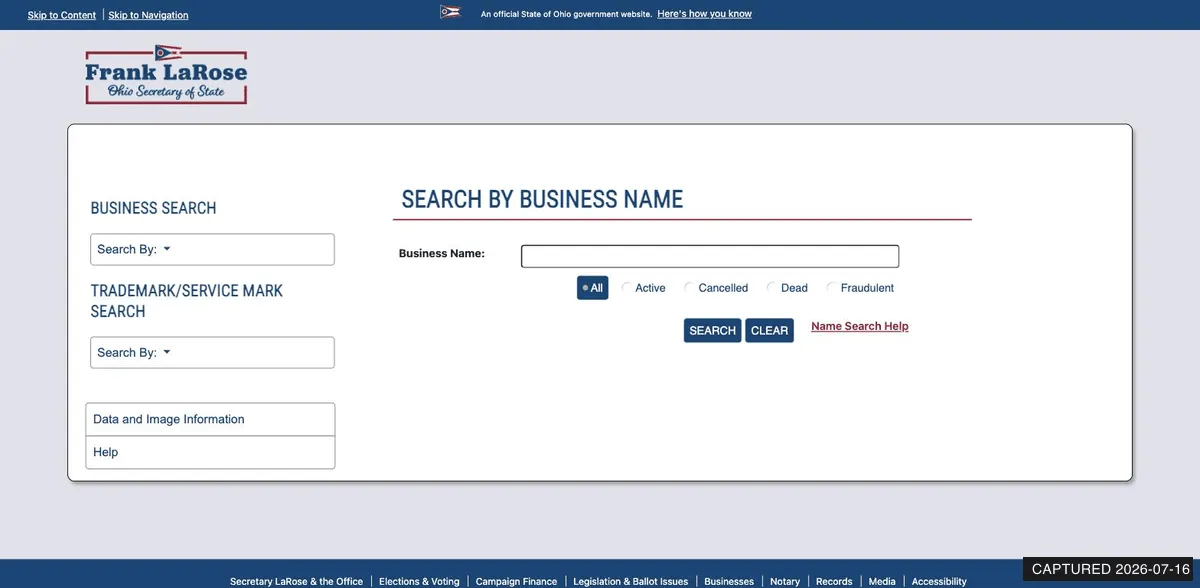
Ohio calls the registered agent a "statutory agent." It must be an Ohio resident or an entity authorized to do business in the state, with a street address on file. You can serve yourself, which puts your address on the public record. A commercial agent lists theirs and signs the acceptance for you.
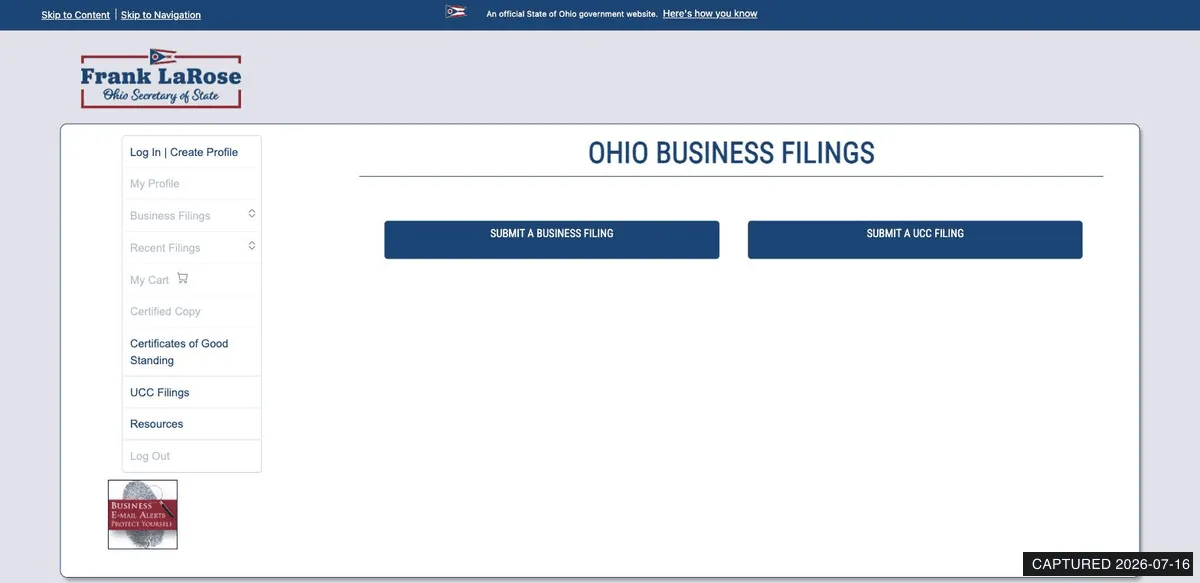
File online through Ohio Business Central. The "Submit a Business Filing" button sits behind Log In | Create Profile, so the first step is a free account. The fee is $99 by card, the lowest filing fee among the states we cover. Regular service processes in roughly 3–7 business days. Paid expedite exists in tiers: 2 business days for $100, 1 day for $200 (walk-in), 4 hours for $300 (walk-in by 1 p.m.).
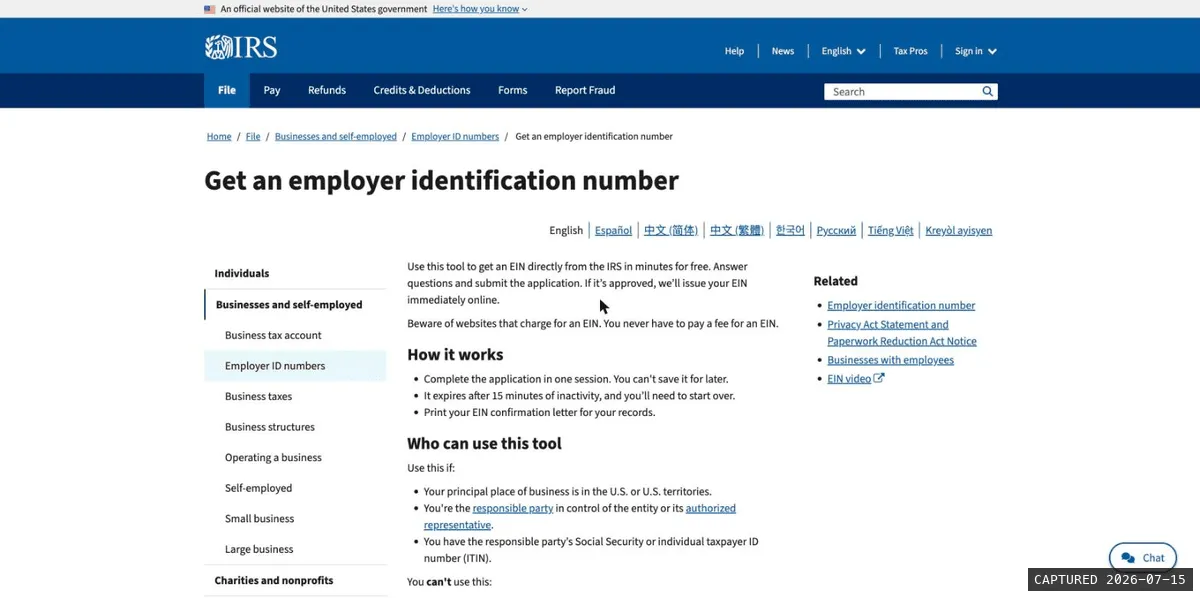
Apply for an Employer Identification Number on the IRS website once the LLC is approved. It is free and takes about ten minutes online; you need it for banking, hiring, and taxes. Ignore any site that charges for an EIN.
Ohio does not require an operating agreement, but banks and partners ask for one and it settles ownership questions in writing before they become disputes. A single-member LLC can use a short standard agreement; multi-member LLCs should document splits and exit terms.
Ohio has no general statewide business license. Many service businesses do need a vendor's license from the Department of Taxation because Ohio taxes a list of specific services; cities and counties add their own permits. For construction specifically: Ohio licenses no general contractor at state level. The Construction Industry Licensing Board licenses heating and air conditioning, refrigeration, electrical, plumbing and hydronics contractors, and it licenses individuals rather than companies, though a contracting company can have a license assigned to it. What reaches a residential builder everywhere in Ohio is Chapter 4722. A home construction service costing $25,000 or more requires a written contract with nine specified terms, one of which is a certificate showing general liability coverage of at least $250,000, and a supplier is defined as someone who keeps that policy in force. Down payments are capped at 10 percent of the contract price.
Ohio LLCs file no annual report, so once the LLC is approved the recurring state paperwork is zero. Open a dedicated business bank account with your filed articles and EIN, and keep the statutory agent information current with the state if it ever changes.
Same state fee either way. The difference is your time, and whose address goes on the public record.
Not at state level. The Construction Industry Licensing Board licenses five trades and it licenses them to individuals: heating and air conditioning, refrigeration, electrical, plumbing and hydronics. Acting as one of those contractors without the license is prohibited, and the Attorney General can be asked to enjoin it. A residential builder who subcontracts those trades is regulated instead through the contract statute in Chapter 4722, and through whatever registration the city requires.
Ten percent of the contract price before work begins, with one exception: up to 75 percent of the cost of a special order item that is otherwise not returnable or usable. Payments from a construction loan are allowed. The cap does not apply to a cost-plus contract, which is also outside the written-contract and excess-cost rules, so the contract form you choose changes which rules you are under.
No. Ohio is the only state among the ten we cover with no annual or biennial report for LLCs, and no recurring Secretary of State fee. Your obligations after formation are keeping the statutory agent current and handling ordinary taxes, including a vendor's license if you sell taxable goods or services.
The $99 files the Articles of Organization (Form 610) and creates the LLC. It does not include an EIN (free from the IRS), a vendor's license if your services are taxable, or local permits. There is no annual report fee to budget; $99 is close to the whole state-side cost.
Source: BusinessFormation.us analysis of U.S. Census Bureau
County Business Patterns 2023 and Nonemployer Statistics 2023
(establishment counts, NAICS 2361), and Business Formation
Statistics (monthly applications); retrieved Jul 2026.
businessformation.us/start/construction-company/ohio/