WITH EMPLOYEES
7,678
U.S. CENSUS CBP 2023
 U.S. FORMATION DATA & GUIDES
 To start a construction company in Pennsylvania you'll file a Certificate of Organization with the Department of State ($125) and get a free EIN from the IRS. Residential remodeling then needs a home improvement contractor registration from the Attorney General's Bureau of Consumer Protection, which costs $100 every two years and involves no exam at all. The trigger looks backward: registration is required once your home improvements totalled $5,000 or more in the previous taxable year. The registration number has to appear in every advertisement, contract, estimate and proposal, and a contract without it is not enforceable against the homeowner. Total state LLC filing: ~$125 and up to 15 business days.
167,957 new business applications in Pennsylvania (last 12 mo) ▲ 15% YoY
Pennsylvania draws two dollar lines and they do different jobs. The first defines the work. A home improvement is repair, remodeling, installation and similar work on a private residence where the total cash price agreed between contractor and owner is more than $500, and the construction of a new home is expressly outside it. The second decides who registers: the act does not reach a person whose home improvements totalled less than $5,000 during the previous taxable year. That line looks backward, which is the part most summaries lose. A company can spend its first year under the threshold and be required to register in its second. The duty also attaches before any tools come out, because nobody may hold themselves out as a contractor, or perform any home improvement, without first registering with the Bureau of Consumer Protection.
What the registration tests is not competence. There is no exam, no experience requirement and no trade classification to pick. The application asks for proof of liability insurance covering personal injury of at least $50,000 and property damage of at least $50,000, a description of the contracting business, and a statement about convictions relating to home improvement, fraud, theft or deception. The fee is $100 every two years, the same for a new application and a renewal, and it is not refundable. Changing details on a registration you already hold costs nothing. Registration, renewal and updates have run through the Attorney General’s online system since 24 April 2026.
The entity question gets its fifth answer here, and Pennsylvania’s looks straight through the company. An LLC is a person under the act and registers in its own name. The application then asks for the name, date of birth, home address, home telephone number, driver’s license and Social Security number of every officer, manager and general partner, the name of each director or individual holding more than a 5% equity interest, and every prior home improvement business any of them operated. The certificate that comes back identifies the individual contractor and the business name together. Forming the LLC still separates business liability from personal liability. It does not keep the people behind it off the application.
The sharpest consequence is contractual rather than administrative. A home improvement contract is not valid or enforceable against the owner unless it is in writing and legible, carries the contractor’s registration number, is signed by both sides, contains the entire agreement with the required notices attached, and states the date, the contractor’s name, address and telephone number, and approximate start and completion dates. A post office box alone does not count as an address. The number also has to appear in every advertisement distributed in Pennsylvania and on all contracts, estimates and proposals. Without it the company cannot enforce the contract it signed. Any violation of the act is also a violation of Pennsylvania’s Unfair Trade Practices and Consumer Protection Law, and home improvement fraud is a separate criminal offense, graded a felony of the third degree above $2,000 and a misdemeanor of the first degree at or below it, one grade higher where the owner is 60 or older.
Pennsylvania also runs a worker classification statute written for construction alone. Act 72 sets who counts as an independent contractor on a construction site: the worker needs a written contract, has to be free from control or direction over the performance of the work, and has to be customarily engaged in an independently established trade or business, with six further factors going to that last test, starting with owning the essential tools and equipment and bearing profit or loss. The Department of Labor and Industry enforces it against employers and against their officers and agents, and the Secretary can petition a court to stop work at the site of an ongoing intentional misclassification. Enforcement is routine rather than theoretical: the department reported collecting $414,398.73 from 138 contractors in 2023. Treating a helper as a subcontractor to keep them off payroll is the most expensive habit a new construction company can bring into this state.
Registration buys something back. Under the act, registering with the Bureau precludes any requirement that a home improvement contractor pay a fee to, or be registered or licensed by, a political subdivision, while towns and cities keep their building permits and code enforcement. Philadelphia shows both halves at once. The city issues no home improvement contractor license of its own and charges nothing extra to permit a registered contractor. It does require a Commercial Activity License, a Business Income and Receipts Tax number, and, for a permit, a certificate of insurance carrying $500,000 of general liability and $300,000 of auto coverage plus workers’ compensation. That liability floor is ten times the state registration minimum, so the insurance a Philadelphia job actually needs is set by the city rather than by the act.
The counts on the plate above make Pennsylvania and North Carolina near twins. Both run about three and a half solo operators for every construction firm with payroll, and both average a little over four employees at the firms that have any. The regulatory models could hardly be further apart. North Carolina examines a person, licenses the company and caps what it may take on. Pennsylvania examines nobody and polices the paperwork of the deal instead. Industry structure produced neither rule, which is a useful check before assuming a neighboring state works the same way.
Your name must include "Company," "Limited," "Limited Liability Company," or an accepted abbreviation like "LLC," and be distinguishable from names already on file. Search existing Pennsylvania entities through the Business Filing Services search before you file.
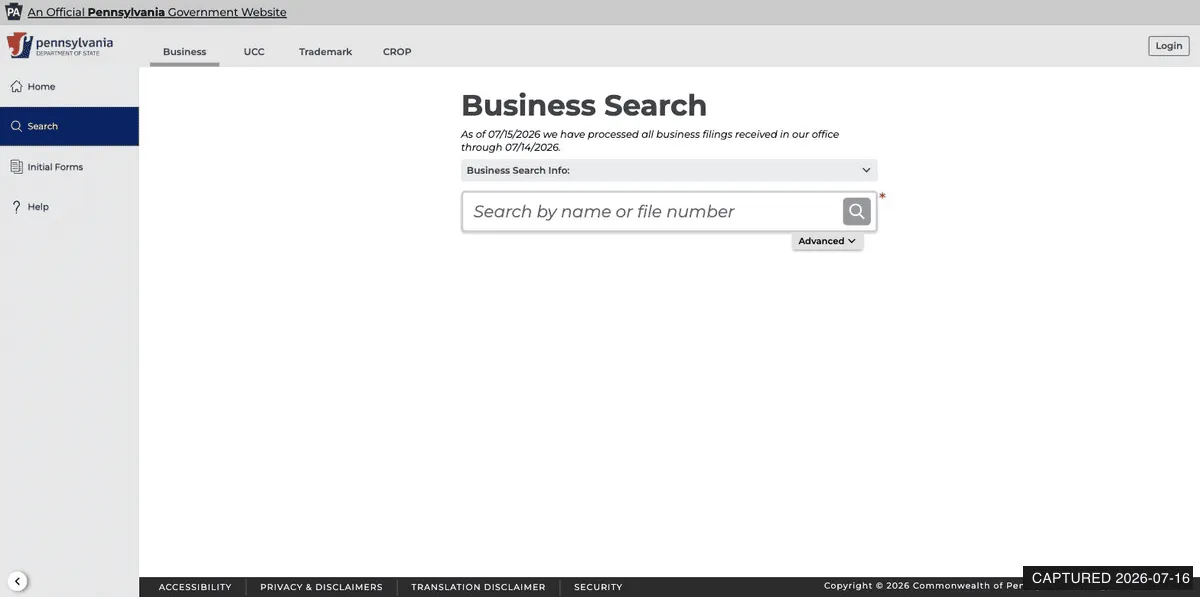
Pennsylvania requires a registered office, a street address in the state where legal papers can be delivered, rather than a named registered agent. You can list your own Pennsylvania address, which becomes part of the public record, or contract with a commercial registered office provider (CROP) that lists its address instead.
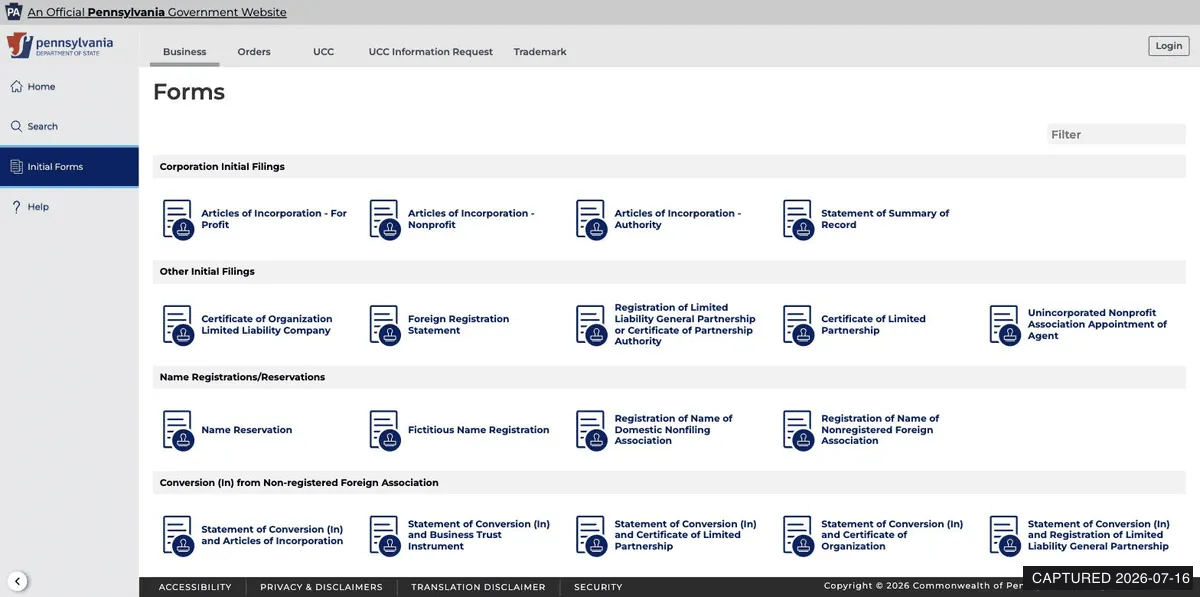
Business Filing Services lists the Certificate of Organization (Limited Liability Company) under Initial Forms; filing it online continues behind a Login. The fee is $125 by card. The Department of State's guidance says to allow up to 15 business days for processing, and online is the fastest channel.
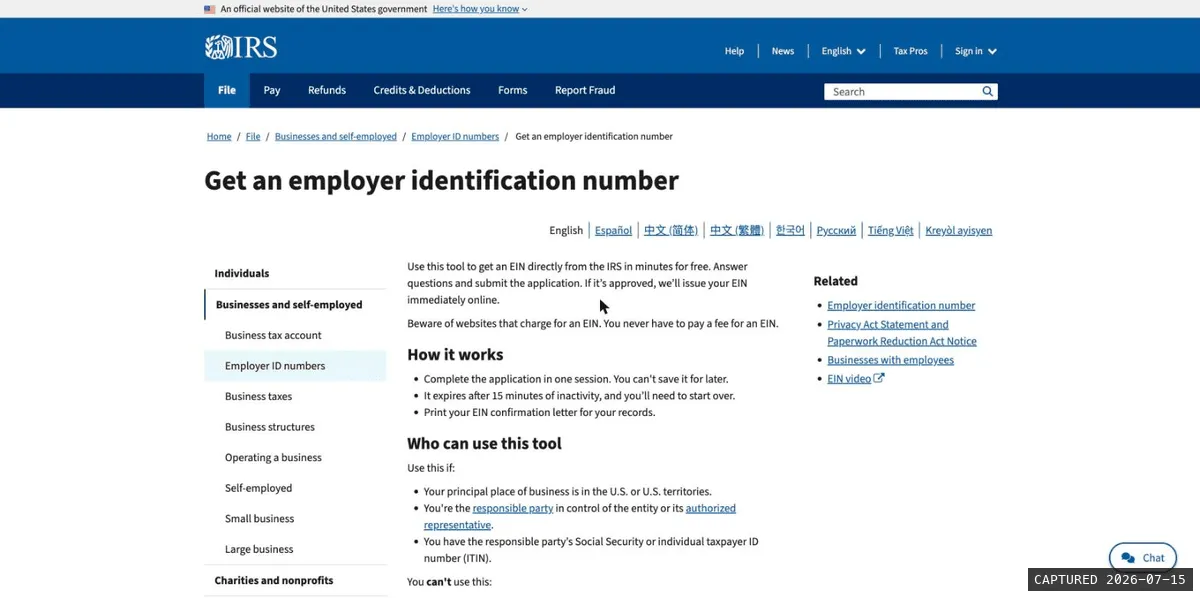
Apply for an Employer Identification Number on the IRS website once the LLC is approved. It is free and takes about ten minutes online; you need it for banking, hiring, and taxes. Ignore any site that charges for an EIN.
Pennsylvania does not require an operating agreement, but banks and partners ask for one and it settles ownership questions in writing. A single-member LLC can use a short standard agreement; multi-member LLCs should document splits and exit terms.
Pennsylvania has no general statewide business license. Cities run their own systems; Philadelphia, for example, requires a commercial activity license before a business operates there. For construction specifically: Pennsylvania runs no contractor exam. The Attorney General's Bureau of Consumer Protection registers home improvement contractors, and registration is required of anyone whose home improvements totalled $5,000 or more in the previous taxable year. Home improvement means work on a private residence priced above $500, and the construction of a new home sits outside the act. The application asks for proof of liability insurance covering personal injury of at least $50,000 and property damage of at least $50,000, and for the name, date of birth, home address and identification of every officer, manager and general partner behind the business. Registration costs $100 every two years, for new applications and renewals alike, and updating existing registration details is free.
Pennsylvania LLCs file an annual report with a $7 fee, due September 30 each year. The requirement started in 2025 and replaced the old ten-year report, so many existing owners have never filed one. Open a dedicated business bank account with your filed certificate and EIN.
Same state fee either way. The difference is your time, and whose address goes on the public record.
Once its home improvements totalled $5,000 or more during the previous taxable year. The test looks backward, so a business under the line in its first year crosses it in the second, and the duty attaches before the work: nobody may hold themselves out as a contractor or perform any home improvement without registering first. Home improvement means work on a private residence priced above $500, and the construction of a new home is outside the act.
No. A limited liability company registers in its own name, and the application still lists the name, date of birth, home address, home telephone number, driver's license and Social Security number of every officer, manager and general partner, plus the name of each director or individual holding more than a 5% equity interest, and the prior home improvement businesses each of them ran. The conviction question is put to the individuals applying even when the applicant is an entity.
Yes, since 2025. Pennsylvania replaced its old decennial report with an annual report due September 30 each year; the LLC fee is $7. The first cohort filed in 2025, so plenty of owners formed earlier have never seen the requirement. Missing it can eventually cost the LLC its good standing.
Pennsylvania words it differently: the requirement is a registered office, a Pennsylvania street address where legal papers can be delivered, not a named agent. Your own address works and becomes public record. A commercial registered office provider (CROP) lists its address instead.
Source: BusinessFormation.us analysis of U.S. Census Bureau
County Business Patterns 2023 and Nonemployer Statistics 2023
(establishment counts, NAICS 2361), and Business Formation
Statistics (monthly applications); retrieved Jul 2026.
businessformation.us/start/construction-company/pennsylvania/