WITH EMPLOYEES
4,361
U.S. CENSUS CBP 2023
 U.S. FORMATION DATA & GUIDES
 To start a landscaping business in North Carolina you'll file Articles of Organization with the Secretary of State ($125) and get a free EIN from the IRS. Landscaping itself stays unlicensed below $30,000 of work at a single job site in any rolling 12 months, the threshold North Carolina's Landscape Contractors' Licensing Board sets under Chapter 89D. Above that line the business needs a licensed landscape contractor and a $10,000 surety bond, and no city or county may set its own, lower threshold. Total state LLC filing: ~$125 and 15–20 business days.
196,775 new business applications in North Carolina (last 12 mo) ▲ 22% YoY
North Carolina is the only other pilot state, besides California, that licenses landscaping through a contractor board rather than a pesticide regulator, and it builds that board differently. California folds the trade into its general contractors board as one classification among many. North Carolina gives landscaping a dedicated board under Chapter 89D, with its own statute defining exactly what the license covers: installing and managing vegetation, horticulture consultation and planting design, landscape drainage and cisterns, low-voltage lighting, and garden features like pools, retaining walls, and patios. Nothing outside that five-part list belongs to this license, which is why the statute spends as much text on what a landscape contractor may not do as on what one may.
The threshold that triggers the license is a dollar figure measured per job site, not per contract, and it resets every rolling 12 months rather than on a calendar. A $12,000 planting job and an $19,000 patio at the same address inside a year add up to a licensed job even though neither contract alone would. A separate provision closes the obvious workaround: no city or county may require a license, or set its own dollar line, for work that stays under the state’s $30,000 figure. Two categories sit outside the threshold entirely regardless of price: golf courses, and an owner doing the work on property they own. One more figure connects landscaping back to general construction. A landscape contractor licensed under Chapter 89D does not also need North Carolina’s general contractor license, but only for landscape work valued at more than $40,000, the same dollar line Chapter 87 uses to trigger general contractor licensing in the first place.
The license comes with a specific, checkable boundary against two other trades. A landscape contractor may run irrigation piping downstream of a backflow prevention assembly without a plumbing license, and wire landscape lighting under 50 volts without an electrical license, and nothing past either line. The statute separately bars a landscape contractor from practicing landscape architecture, engineering, well contracting, irrigation contracting under its own separate license, architecture, or electrical contracting outright. Qualification for the license itself is a $10,000 surety bond or irrevocable letter of credit that functions as a claim fund: a customer injured by a licensee’s violation can sue the licensee and the bond together, not just the company. As with California, the entity has to exist before the credential: North Carolina licenses the business, so the Secretary of State filing comes first and the board application, exam, and bond follow.
The density figures put North Carolina in the middle of the ten pilot states rather than at either end. It ranks fifth for solo landscaping operators and fifth for total landscaping employment, but eighth for employer locations, a wider gap between the two employer-side ranks than most pilot states show. Fewer North Carolina landscaping businesses carry payroll than the employment rank alone would suggest, and the ones that do run crews larger than their employer-location rank implies, a shape closer to Georgia’s chemical-regulator market than to California’s contractor-board one. The $30,000 threshold sits well above what a single crew typically bills in a season, which is consistent with a state where most landscaping businesses never meet the board at all.
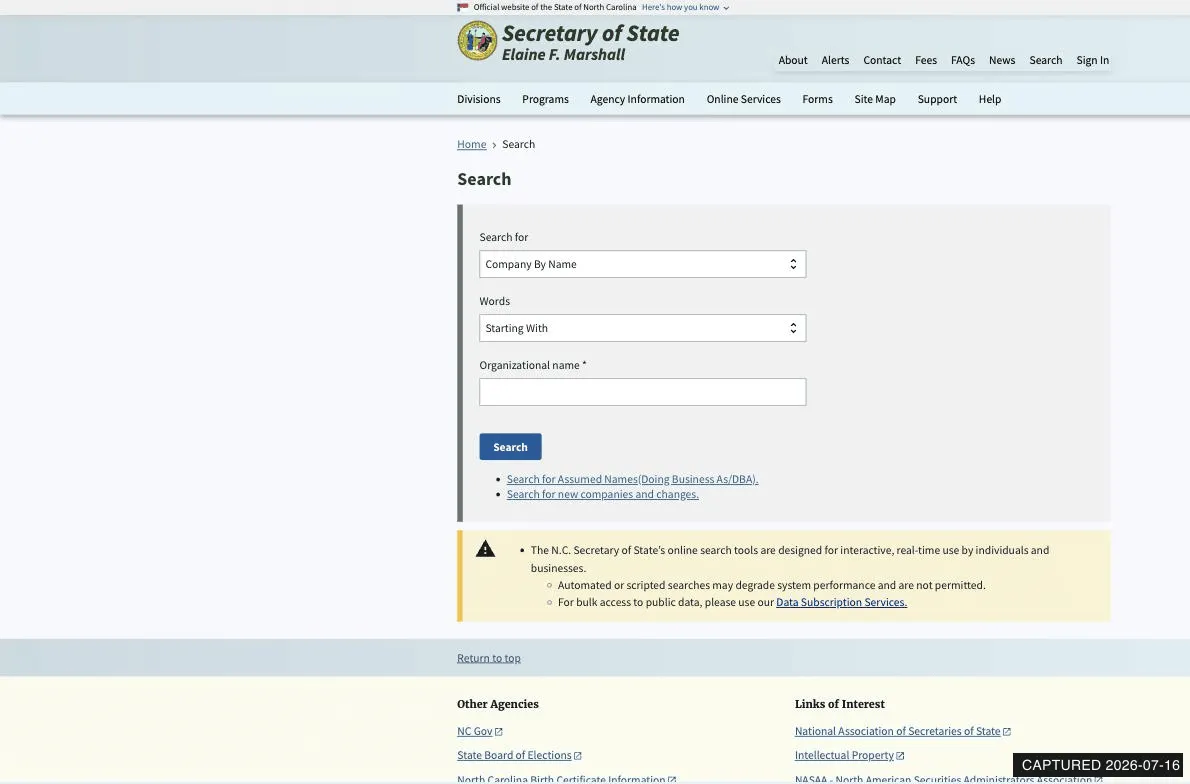
Your name must include "LLC" or "L.L.C." and be distinguishable from entities already registered in North Carolina. Search existing names through the Secretary of State's business search at sosnc.gov before you file; a conflict gets the filing rejected.
North Carolina requires a registered agent with a physical street address in the state, available during business hours. You can serve yourself, which puts your address on the public record. A commercial agent lists theirs instead.
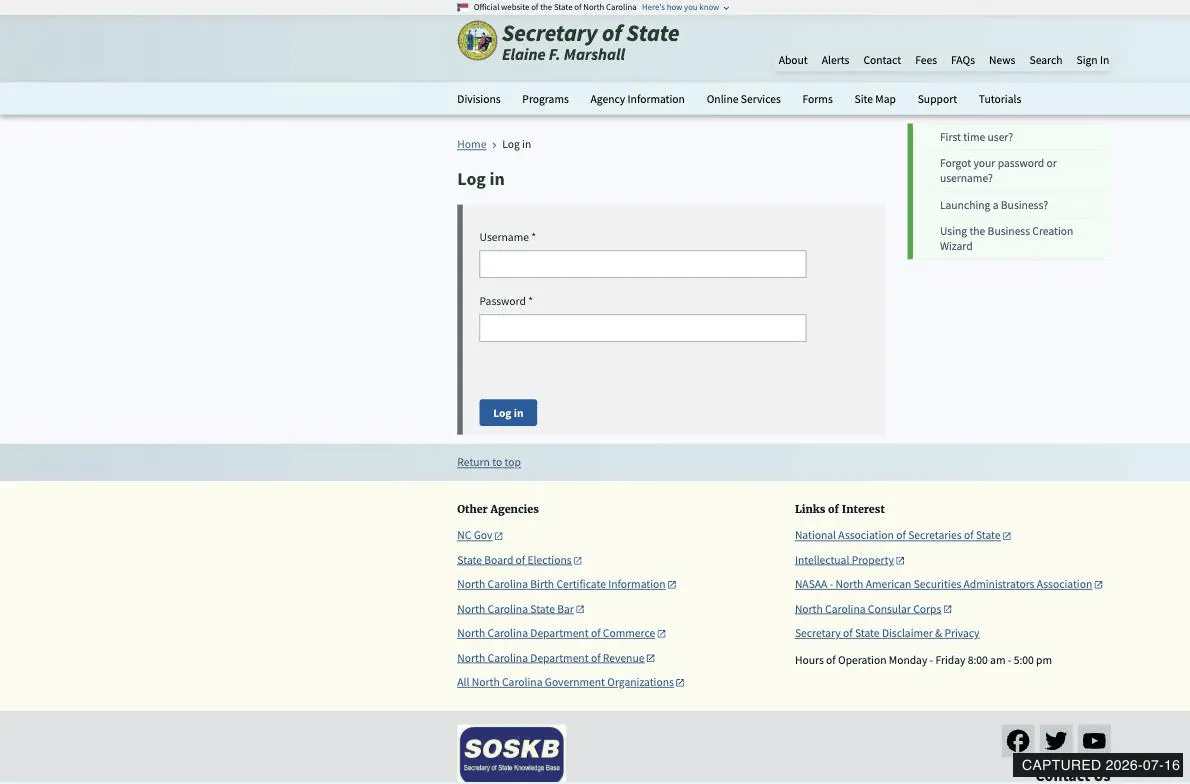
Start the Online Business Registration wizard at sosnc.gov and it redirects straight to a Log In screen, so the first real step is creating a free sosnc.gov account. From there the fee is $125 by card. The state's published turn-around for entity creation is 15–20 business days, with online the faster channel. If you cannot wait, $100 buys 24-hour processing and $200 same-day.
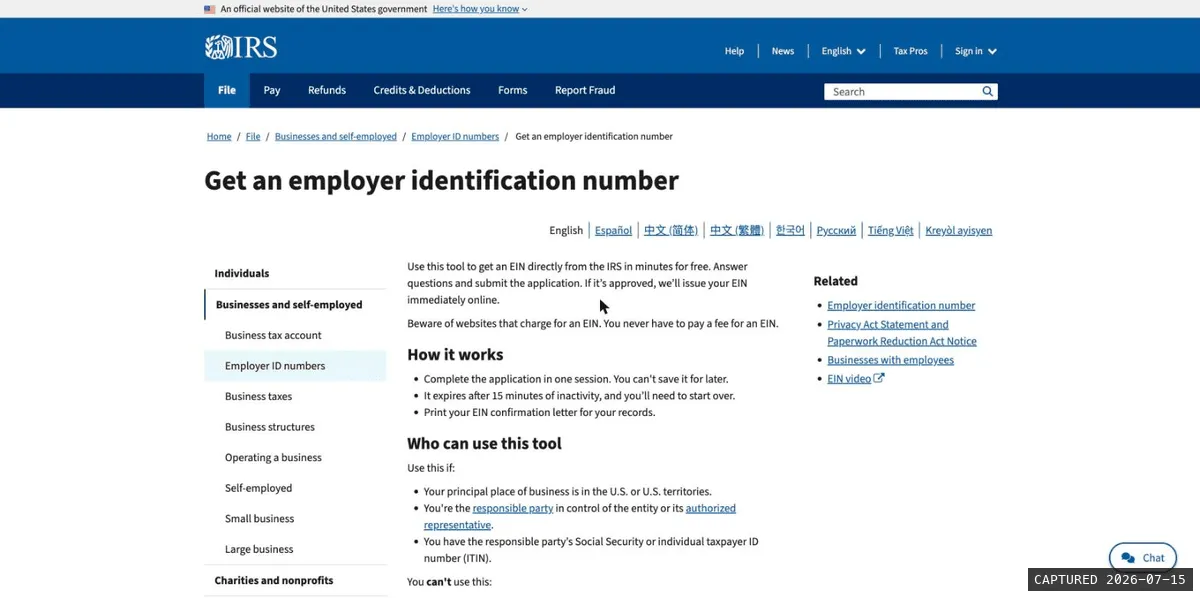
Apply for an Employer Identification Number on the IRS website once the LLC is approved. It is free and takes about ten minutes online; you need it for banking, hiring, and taxes. Ignore any site that charges for an EIN.
North Carolina does not require an operating agreement, but banks and partners ask for one and it settles ownership questions in writing. A single-member LLC can use a short standard agreement; multi-member LLCs should document splits and exit terms.
North Carolina has no single statewide business license. Requirements come from state occupational boards and from city or county rules; check both where the work actually happens. For landscaping specifically: North Carolina licenses the trade through its own Landscape Contractors' Licensing Board under Chapter 89D, a separate board from the one that licenses general building work. The threshold is $30,000 or more of labor, material, and other contracted items at one job site in any rolling 12-month period, not a per-contract test, and no local government may require a license for work under that line. A licensed contractor posts a $10,000 surety bond that doubles as a claim fund: an injured customer can sue the licensee and the bond together. The license also draws a boundary at the backflow prevention assembly: a landscape contractor can run irrigation piping downstream of one without a plumbing license, and install landscape lighting under 50 volts without an electrical license, but nothing past either line. Fees run $100 to apply, $100 for the license and each renewal, $250 for the exam, with renewal due every 1 August.
North Carolina LLCs file an annual report due April 15 each year after the year of creation: $203 filed online by card, $200 by paper. Open a dedicated business bank account with your filed articles and EIN to keep liability protection intact.
Same state fee either way. The difference is your time, and whose address goes on the public record.
Only once a single job site totals $30,000 or more in labor, material, and other contracted items over any rolling 12 months, or the business uses the title "landscape contractor." Below that line, no state license applies, and a city or county may not set its own lower threshold either. Golf courses and owners working on their own property are exempt regardless of the dollar figure.
Yes, within limits the statute states exactly. A licensed landscape contractor can run irrigation piping downstream of a backflow prevention assembly and install landscape lighting under 50 volts on a cord and plug, both without a separate plumbing or electrical license. Connecting upstream of that backflow assembly, or wiring above 50 volts, crosses into work a plumber or electrician has to do instead.
The Secretary of State's published turn-around for entity creation is 15–20 business days, the slowest standard processing among the states we cover, and online filing is the faster channel. Paid expedite shortens it: $100 for 24-hour processing, $200 for same-day.
The state sets the LLC annual report fee at $200 ($203 filed online by card), the highest recurring state cost among the ten states in this pilot. It is due April 15 every year after the creation year. Late or skipped reports lead to administrative dissolution, so calendar it with your taxes.
Source: BusinessFormation.us analysis of U.S. Census Bureau
County Business Patterns 2023 and Nonemployer Statistics 2023
(establishment counts, NAICS 56173), and Business Formation
Statistics (monthly applications); retrieved Jul 2026.
businessformation.us/start/landscaping-business/north-carolina/