WITH EMPLOYEES
5,568
U.S. CENSUS CBP 2023
 U.S. FORMATION DATA & GUIDES
 To start a landscaping business in Texas you'll file a Certificate of Formation with the Secretary of State ($300) and get a free EIN from the IRS. Texas has no landscape contractor license at all. Any irrigation work, selling, designing, installing, maintaining, altering, repairing, servicing, or inspecting a system, needs a TCEQ license under 30 TAC Chapter 344 ($111, 3-year term). Applying any pesticide to plants for hire needs a separate TDA category 3A license, and every vehicle a landscape-maintenance pesticide business uses needs a state-issued decal. Total state LLC filing: $300 and 5–10 business days.
574,866 new business applications in Texas (last 12 mo) ▲ 17% YoY
Texas is one of six pilot states where a chemical regulator, not a contractor board, claims the landscaping trade, but it is the only one of the six that splits the claim between two agencies rather than one. There is no landscape contractor license anywhere in the state. Touching an irrigation system in any way, selling, designing, installing, maintaining, altering, repairing, servicing, or inspecting one, or consulting on one, needs a license from the Texas Commission on Environmental Quality. Applying any pesticide to plants, trees, shrubs, grass, or other horticultural plants for a fee needs a separate license from the Texas Department of Agriculture. A crew that only mows and edges, touching neither a sprinkler system nor a chemical, needs neither credential.
The irrigation credential runs under 30 TAC Chapter 344, and it reaches past installation into selling, designing, maintaining, altering, repairing, servicing, and inspecting a system, plus consulting on one. Three license types split the work: a Landscape Irrigator holds the full scope, an Irrigation Technician does the same work but only under an irrigator’s direct supervision, and an Irrigation Inspector checks systems rather than building them. The exam pass mark is 70%, the fee is $111 for both the initial license and each renewal, and the license runs a 3-year term with continuing education that ranges from 16 to 24 hours depending on which of the three the holder carries.
The pesticide side runs on Texas Department of Agriculture category 3A, and the trigger is the first application for hire, whatever the product’s classification. A business needs a commercial 3A license if it uses restricted-use, state-limited-use, or regulated herbicides, and a noncommercial one if it sticks to general-use products; either way the applicator recertifies annually with five continuing education units. Financial responsibility runs $100,000 property damage and $100,000 bodily injury per occurrence, or a $200,000 general aggregate. The business license fee is set by type rather than by category: $200 a year commercial, $140 noncommercial, $75 for a noncommercial business employed by a political subdivision or federal agency. Texas skips the lawn sign four other pilot states require and marks the truck instead: every vehicle a landscape-maintenance 3A business uses needs a TDA-issued vehicle identification decal, visible proof a customer or inspector can check without asking to see paperwork.
No pilot state has more solo landscaping operators than Texas: about 58,000, ahead of California’s roughly 50,000 and Florida’s roughly 48,000. Payroll tells a different story. Texas drops to fourth for employer locations and third for total employment, a three-place gap between its solo rank and its employer-location rank, wider than Florida’s two-place spread and narrower than Georgia’s six-place one. Roughly ten and a half solo operators exist here for every location with payroll, more than double the industry’s national average of four to one, a ratio that fits two credentials built around an individual license holder rather than a bonded company.
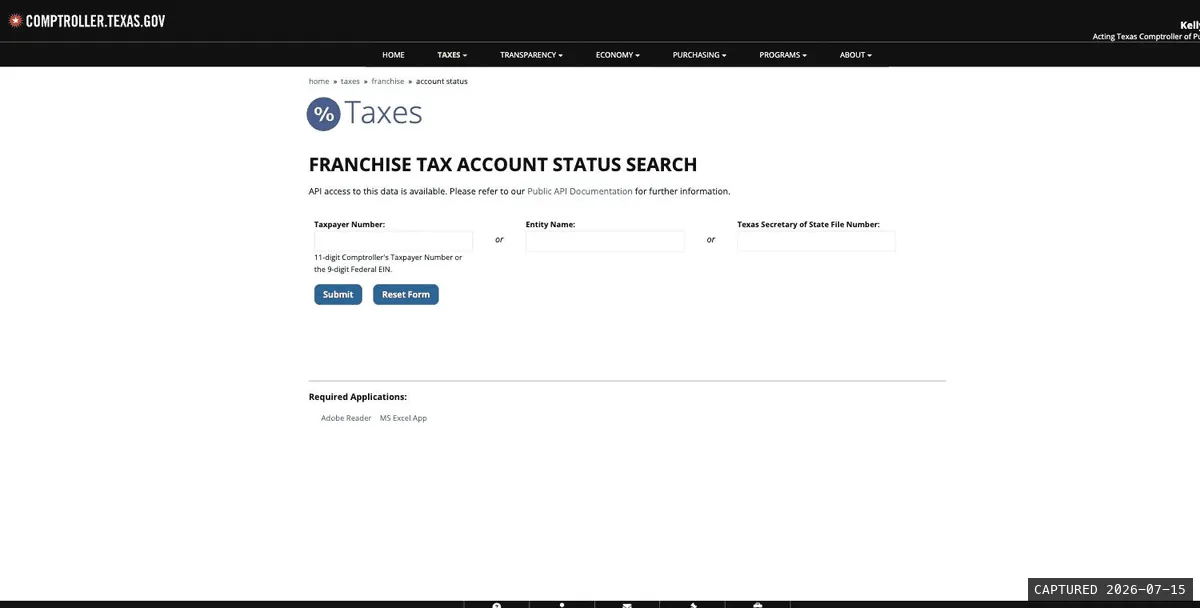
Pick a name that includes "LLC" or "L.L.C." and isn't already taken. Check existing Texas entities free through the Comptroller's taxable entity search: enter your candidate in the "Entity Name" field and review what is already registered. The Secretary of State makes the final availability call at filing (its own SOSDirect search charges a $1.00 statutory fee per search), so a close match here is your signal to pick something more distinct.
Texas requires a registered agent with a physical street address in the state who is available during business hours. You can serve as your own agent, which puts your address on the public record. A commercial agent lists theirs instead and files the consent form for you.
Texas e-filing runs through SOSDirect, and the whole filing side sits behind a login: from the landing page you enter the site, create a session, choose "Domestic Limited Liability Company (Form 205)," enter your business name exactly as you researched it, and pay the $300 state fee by card. Most filings are approved in 5–10 business days.

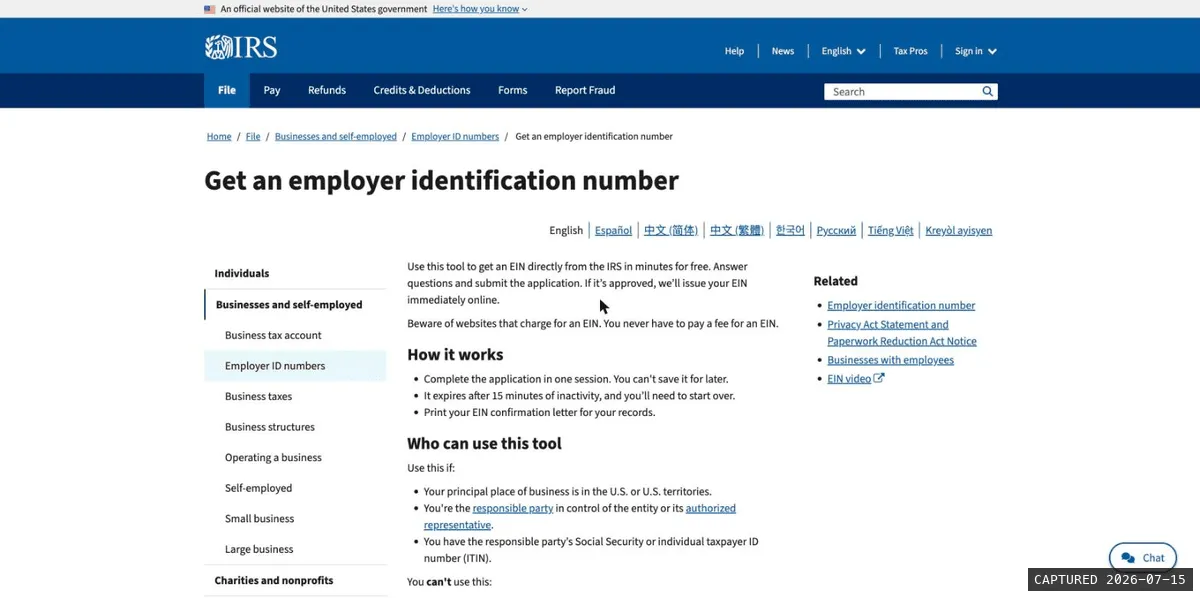
Once the LLC is approved, apply for an Employer Identification Number on the IRS website. It is free, takes about ten minutes online, and you need it to open a bank account, hire, and file taxes. Ignore any site that charges for an EIN.
Texas doesn't require an operating agreement, but banks and partners often ask for one, and it settles ownership questions before they become disputes. A single-member LLC can use a short standard agreement; multi-member LLCs should spell out splits and exits.
Texas has no general statewide business license. Check your city and county for local permits before you take your first job. For landscaping specifically: Texas issues no landscape contractor license of any kind. Two separate state credentials catch the work instead, and which one applies depends on what the crew actually does. Any irrigation work, selling, designing, installing, maintaining, altering, repairing, servicing, or inspecting a system, or consulting on one, needs a TCEQ license under 30 TAC Chapter 344. Three license types cover it: Landscape Irrigator, Irrigation Technician (who works only under an irrigator's direct supervision), and Irrigation Inspector. The exam pass mark is 70%, the fee is $111 for both the initial license and each renewal, and the license runs a 3-year term with continuing education that ranges from 16 to 24 hours depending on license type. Applying any pesticide, of any classification, to plants, trees, shrubs, grass, or other horticultural plants for hire needs a separate Texas Department of Agriculture license in category 3A: commercial if restricted-use, state-limited-use, or regulated herbicides are involved, noncommercial if the products used are general-use only. It recertifies every year with 5 continuing education units. Applicator-business financial responsibility runs $100,000 property damage and $100,000 bodily injury per occurrence, or a $200,000 general aggregate. The license fee is set by license type, not by category: $200 a year commercial, $140 noncommercial, and $75 for a noncommercial business employed by a political subdivision or federal agency, so a 3A landscape-maintenance business pays whichever applies to what it actually sprays. Every vehicle the business uses in the landscape-maintenance subcategory of 3A must carry a TDA-issued vehicle identification decal.
Texas LLCs file an annual franchise tax report; most small businesses owe $0 under the no-tax-due threshold but must still file. Open a separate business bank account with your approved certificate and EIN to keep liability protection intact.
Same state fee either way. The difference is your time, and whose address goes on the public record.
No, Texas issues no landscape contractor license of any kind. Two other state credentials can still apply: a TCEQ license under 30 TAC Chapter 344 for any irrigation work, and a Texas Department of Agriculture category 3A license for applying pesticide to plants for hire. A crew that only mows, edges, and prunes, touching neither an irrigation system nor a chemical, needs neither one.
It is set by license type, not by category, under 4 TAC §7.20(d)(2): $200 a year commercial, $140 noncommercial, and $75 for a noncommercial business employed by a political subdivision or federal agency. A landscape-maintenance 3A business pays whichever applies to what it sprays, and every vehicle it uses in that subcategory needs a TDA-issued decal.
Yes. Any Texas resident over 18 with a physical street address in the state can serve, including yourself. The trade-off is privacy: the agent's name and address go on the public record, and you must be available at that address during business hours to receive legal documents.
The $300 is the state's one-time fee for filing the Certificate of Formation (Form 205), which creates the LLC itself. It does not include a registered agent service, an EIN (free from the IRS), or the annual franchise tax report you file to stay in good standing.
Source: BusinessFormation.us analysis of U.S. Census Bureau
County Business Patterns 2023 and Nonemployer Statistics 2023
(establishment counts, NAICS 56173), and Business Formation
Statistics (monthly applications); retrieved Jul 2026.
businessformation.us/start/landscaping-business/texas/